Shivpreet Singh
Shivpreet Singh
  • Home
  • Music
    • Spotify
    • Apple Music
    • Amazon
    • Pandora
    • SoundCloud
    • Google
    • You Tube
      • Music on YouTube
      • Uplifting Shabads
      • Guru Nanak Shabads
      • Meditation & Chanting
      • Shabads for Kids
      • Shabads of Guru Arjan
      • Shabads of Guru Gobind Singh
  • Videos
    • Latest
    • Popular
    • Uplifting
    • Guru Nanak
    • Meditation
    • For Kids
    • Guru Arjan
    • Guru Gobind Singh
  • Projects
    • DhunAnand Foundation
    • Pandemic 2020
    • Guru Nanak 550
    • Namdev 750
    • Thoughts and Ruminations
    • What I Love to Read
  • News
  • Meet Me
    • Meet Me
    • Request
    • Send Email
    • Newsletter
    • FAQs
  • About
    • Biography
    • Photos
    • Music
    • FAQs
I decided to spend a year to spend a year working on compositions of Guru Nanak for #GuruNanak550. Someone asked me write about this experience and this is what I said:

Singing Guru Nanak 

For a YearAs long as I sing, I live. As soon as I forget, I die
(So Kyon Visrai)
- Guru Nanak, Raag Asa

On the momentous occasion of Guru Nanak's 550th birth anniversary celebrations, I decide to spend a year meditating upon the words and music of Guru Nanak. Its exciting ... For many years Bhai Gurdas has reminded me how Guru Nanak lighted his life, Kal Taaran Guru Nanak Aaya. I commence excitedly, focusing on the light that is brighter than one hundred moons and one thousand suns combined, the light of Guru Nanak’s prayer, the universal Aarti with the stars studded in the sky’s platter.


I decide to sing Guru Nanak completely this year. The initial plan is to record 55 new compositions. I think this to be momentous because normally I can only do 10-12 compositions in a year. This is also momentous because I will sing shabads that are rarely heard and expound raagas rarely explored. But mostly it is momentous and exciting because I will live with the sweet words of the Guru and have them recorded for myself to hear for the rest of my life.

I start out with a live recording of an album, Guru Nanak's Elemental Meditations. I invite 5 musicians to my home to record an improvisation album of the Mool Mantra. Musicians from three continents come together for 2 hour of bliss. 

And then I move on to Guru Nanak's shabads, from Vadde Mere Sahiba in Raag Asa to Har Bin Jio in Raag Sri to Haun Dhadi in Raag Majh and so on. Like Rang Rataa, the universal power he sings for, Guru Nanak songs are multicolored. They are filled with humility and love, courage and fortitude, truth and bliss. The words are so apt for me. Every one touches the heart. I find it truly amazing that the Guru writes these shabads for me. Often I am just left in wonder. Waheguru Satnam!

Days go by, weeks and then months. I am enjoying this a lot compared to previous years. Instead of meandering through the various colors of the oneness randomly. Through singing Guru Nanak, I am focused on singing One, singing Ek Onkaar, singing Naam.

Within a few months, I realize things are going really well, and music is descending upon me faster than it ever has. I am loving it, and I don’t want to count where I am to see if I am done with 55. That would be very sad. I don’t want it to end. So, I remove the numbered list on my laptop. I stop counting my compositions. Singing Guru Nanak cannot be caged in limits. Akaal!

Now with about a month left for Guru Nanak’s 550th anniversary, I have far exceeded my original number of compositions. But I feel like I have not even the scratched the surface of the Guru's ocean. I have not even begun the sing Guru Nanak.

His message is precipitating upon me. San Ramon has the sweet fragrance of Dharamsaal Kartarpur.
Singing is his life and singing is his lesson. Different shabads and raags are amalgamating into one. The simplicity of his message is amazingly elegant. Remember Naam sings Baba Nanak. That is his only message. Just that one. One! No other ritual is needed, no higher prayer, no sweeter song, no farther travel, no purer cleansing, no quieter silence, and no fuller symphony.

Remember Naam is the incessant song weaved through all Remember Your True Essence he chants in all his words. In all kinds of darkness, the best answer is to sing the true essence. And no one is bereft of this true essence. At the Guru’s gate everyone is singing. Everything is singing. The wind singing in its blowing. The water sings in its flowing. The fire sings in its burning. The planets sing in their revolving. Because the Guru makes them. 

Likewise, in acceptance, I sing too. I sing because what better purpose of life there is. I sing Tere Gun Gaavaan as it was sung by Bhai Samund Singh a hundred years ago. Like Guru Nanak did 500 years ago. Or do I? 

I used to think I sing, but with the Guru’s grace the singing just happens. The Guru just sings and I float in his boat. He takes me across ... Gur Taar Taaranhareya like he did in Ramkali 50 years ago. The decision is not mine. The singing is not mine either. All power is His. Aakhan Jor Chupai Na Jor. Singing Guru Nanak for a year is impossible. This singing continues and promises never to end. Such grace upon me is momentous. 

Playlist of recordings related to this project:
Sant Singh Maskeen ji always talks about Puranas as "Mithihaas" which is the opposite of "Itihaas" ... something that was made up compared to something that truly happened.  I wanted to find out if it was just him saying this and whether this is commonly used by Vedic philosophers.  According to the shastraas it seems "Mith" is different from the english mythology.  I found this interesting essay on "Mithya" ... which delves into this word into more depth.  Shankara's kArikA defines Mythia in the following way:
saprayojanataA teShAM svapne vipratipadyate |
tasmAdAdyantavattvena mithyaiva khalu te smRRitAH ||

The utility (of the objects seen in the waking state) is contradicted by the dream state. (Objects) have to be regarded as mithyA since they have a beginning and an end.

So the search goes on ... 

Here is the article: 

https://www.advaita-vision.org/origin-and-meaning-of-the-word-mithya/

Seekers often ask questions about the meaning of the word mithyA. It is, after all, one of the most important concepts in Advaita. Someone has just asked about the usage of the word itself: Did Shankara use it? Does it occur in the Upanishads? I had to do a bit of research on this one and thought others might be interested in what I discovered.

The dictionary definition of the word gives: 1) contrarily, incorrectly, wrongly, improperly; 2) falsely, deceitfully, untruly; 3) not in reality, only apparently; 4) to no purpose, fruitlessly, in vain. According to John Grimes, it derives from the verb-root mith, meaning ‘to dispute angrily, altercate’.

It seems that it only occurs in one Upanishad – the muktikopaniShad. This is the Upanishad which tells you which Upanishads you need to study in order to obtain mokSha or mukti. It says that you can, in theory, get away with studying only one – the Mandukya, with its bare 12 sutras. If this alone does not enlighten you, then you need to study the 10 major Upanishads (Isha, Kena, Katha, Prashna, Mundaka, Mandukya, Taittiriya, Aitareya, Chandogya and Brihadaranyaka). If you still haven’t got it, there are a further 22 making up the main ones. Failing that, you are doomed to have to study the 108 commonly recognized ones. (After that, you start again!)

Obviously, the muktika itself has to be a relatively recent Upanishad since it is able to name these 108. (The muktika awards itself 108th position.) It seems certain that it was written after Gaudapada’s kArikA-s on the Mandukya Upanishad. (The best guess seems to be that it was written prior to 1656CE.) If this is the case, then it also seems probable that the reason this Upanishad mentions the word mithyA is because Gaudapada himself uses it.

It occurs in kArikA-s 2.7 and 4.32. Since these verses are identical, the word is effectively only used in one place prior to Shankara. The kArikA reads:

saprayojanataA teShAM svapne vipratipadyate |
tasmAdAdyantavattvena mithyaiva khalu te smRRitAH ||

The utility (of the objects seen in the waking state) is contradicted by the dream state. (Objects) have to be regarded as mithyA since they have a beginning and an end.

In the section where this occurs, Gaudapada is refuting the various suggestions about what makes an object ‘real’. One of these is that, if an object has utility, then it must be real. Thus, for example, I see a glass of water on the table; I pick it up and drink it and my thirst is quenched. Therefore that glass of water must have been real. But the glass of water seen in a dream quenches the thirst of the dreamer. On waking, however, it is realized not to have been real. In fact, the waking glass of water is totally useless to the dreamer. Accordingly, utility cannot be a relevant factor in determining what is real. (Otherwise, we would have to conclude that reality was relative.) What we have to say is that the dream world is useful to the dreamer and the waking world to the waker. Both worlds are ‘relatively real’ but neither is absolutely real.  Hence there is the need for a new word to describe them – mithyA.

A good metaphor for this is ‘fatherhood’. If X is the father of Y who in turn is the father of Z, then we can say that the ‘fatherhood’ of Y is real from the standpoint of Z but not from the standpoint of X. It is a relative term only and has no absolute reality.

Objects are not real because they can be sublated (in the way that the rope-snake can be realized to be a rope). Chairs can be realized to be only wood; waves to be water; water to be H2O etc. But they are not unreal because we can perceive them; they have utility and so on.

(As an aside, the word is also used in the Bhagavad Gita 18.59 but here it is used in the sense of ‘vain, untrue, hopeless’: “Your resolve will be in vain”. This is the fourth of the definitions given above.)

The Muktika quote is from 2.14:

janmAntashatAbhyastA mithyA sa.nsAravAsanA |
sA chirAbhyAsayogena vinA na kshIyate kvachit ||

Krishna Warrier translates this: “The false impression of worldly life is got in a hundred lives and cannot be destroyed without long practice.”

 Certainly the concept, if not the word, occurs in the Vedas (Upanishads). The tadananyatvAdhikaraNam topic (Brahmasutras chapter 2.1.14-20 or 15-21 depending upon which version you have) is all about this. ‘The world (effect) is non-different from Brahman (the cause)’ etc. The idea is that ‘everything’ which might be considered to be a modification of this cause is mithyA and therefore does not exist separate from Brahman. Shankara quotes Br. U. 4.5.6 and 2.4.6 and Ch. U. 6.1.1 as examples where this is taught. The latter is the famous vAchArambhaNa section which I have written about elsewhere, the idea that we effectively bring something into existence by giving it a name.

I think that basically, it is a word hit upon later by commentators as a good word for the idea conveyed by Shankara et all when talking about the nature of the universe. There are five definitions encountered in Advaita. The best book I have come across for discussing these is ‘The Fundamentals of Advaita’ by K. Narain, Indological Research Centre, 2003; ISBN 81-88260-00-2 (but beware – although it is called ‘fundamental’, it is actually quite difficult reading!).

The first definition equates mithyA with anirvachanIya – indefinable or inexplicable. Narain spells it out as “that which is not the substratum of either being or non-being”. This is often encountered as sad-asad-vilakShaNa, other than real or non-real. If analyzed, it is found that this could mean several things. What is meant by Advaitins is that a mithyA object has two properties: ‘the absolute negation of being’ and ‘the absolute negation of non-being’. Other philosophies regard this as contradictory! The advaita siddhi by madhusUdana discusses all the intricacies of logic here and refutes the objectors. But, if Narain is ‘difficult’, the advaita siddhi is incomprehensible!

The second definition uses the concept of ‘counterpositive’ (pratiyogin) and many people (including myself) have great difficulty getting their heads around it! It is discussed in detail in Madhavananda’s vedAnta paribhAshA, probably the most difficult text on Advaita (epistemology) that I have ever encountered. Acharya Sadananda wrote an extensive commentary on the first part of this work for the Advaitin group and I edited this extensively for the site (the ‘Knowledge’ series, parts 1 and 2, with around 70 separate essays). There is an interpolated essay on the concept of ‘counterpositive’ by S. N. Sastri at http://www.advaita.org.uk/discourses/knowledge/counterpositive.htm. There, he gives an example which comes closest for me to explaining the meaning:

If one makes a statement such as: “There is no pot on this floor” or “A pot does not exist on this floor”, the pot is the counter-positive of its own non-existence and the floor is the substratum. A person sees a rope and thinks it is a snake. Afterwards he finds out that it is only a rope. Then he says, “There never was a snake here”. Another way of saying this is, “There is absolute non-existence of a snake here”. In this sentence the snake, whose non-existence is stated, is the counter-positive. The rope in front is the substratum. So we can say that the snake is the counter- positive of its own absolute non-existence in the rope which was the substratum on which it was seen, i.e. which was supposed to be its substratum. The expression “non-existence that abides in the substratum” means only “the non-existence in the substratum”. Thus what the sentence quoted above means is: That which appeared to exist at a particular place, but was found later to be non-existent there is mithyA. The snake appeared to exist where the rope was, but later on it was found that it did not exist. So the snake is mithyA.

So the second definition, utilizing this concept is: (mithyAtva is) the counter-positive of absolute negation with reference to the substratum in which it is cognized. As Narain puts it, which is just about understandable, “when Advaitins affirm that a jar is ‘unreal’ (i.e. mithyA) they mean: ‘it is capable of being absolutely denied (with reference to past, present and future) in regard to the point of space and time in relation to which it is cognized’, like ‘silver’ in ‘conchshell’ (or nacre).” Again, there is lots of to and fro argumentation in respect of this definition if you have the intellect able to tackle it!

The third definition was given by Citsukha, an Advaitin who lived around the 13th century CE. He suggested the (much simpler!) one that mithyAtva is that which possesses the specific character that it is sublated by knowledge. The obvious example would be the snake that we see in the dark which, when light (knowledge) is brought to the subject, is realized to be a rope. If it had been real, then knowledge could only reinforce the belief. Only those things that are mistakenly perceived can be altered as a result of knowledge. But misperceived snakes etc cannot be regarded as totally unreal either, since they have their effects on our metabolism. So, being neither real nor unreal, we use the word mithyA.

It was noted above that other philosophies, such as dvaitins, argue against all of these definitions. As an aside, an interesting one relating to this definition is as follows. As it stands, the idea is that it is knowledge that, in a moment of realization, reveals an object previously thought to be real as false. One of the key Dvaitins (Vyasatirtha) asked whether a jar that has been destroyed by a stick in the past is false. Here, the jar is ‘terminated’ by the stick and not by knowledge! Therefore, the jar must have been real before its destruction! This resulted in further arguments and refining of definitions – but I am not going to attempt to go into this here. (It involves more ‘counterpositives’.)

The fourth definition is again from Citsukha and is a slight modification of the second. mithyAtva is the character of being the counterpositive of absolute negation located in its own substratum. The example that is used a cloth, consisting of woven threads. The cloth only exists in conjunction with the threads – it is never seen anywhere else. And we cannot attribute separate reality to it where it is seen either, since we know it is only an arrangement of the threads. So we say that it is the counterpositive of absolute negation located in the threads, and we say that the cloth is mithyA.

The final definition is that mithyAtva is something distinct and different from ‘real’. This proved to be a bit too indefinite and the advaita siddhi amplifies this to explain that the word ‘real’ means “established by pramANa, unrelated to any of the defects that have their final causality in avidyA and uncontradicted at all times (past, present and future)”.

Nowadays, the word mithyA is very commonly used. We use it to describe everything in ‘creation’. The world appears to be real but, when Self-ignorance is removed, we realize that it is the substratum – brahman – that is the only reality. Thus the world (which we still see, and which is therefore not unreal) is known not to be real. Accordingly, we require the word mithyA to talk about it. It is not a synonym for vyavahAra. Everything in vyavahAra is mithyA, but dreams are mithyA too and they are prAtibhAsika.

The standard text for all of this is the Advaita-Siddhi itself and, strictly for the most intrepid souls, this is available in the Indian Philosophical Classics series: advaita-siddhiH, madhusUdana sarasvatI, translated and explained by Karuna Bhattacharya, Motilal Banarsidass, 1992. ISBN 84-85636-00-1. The five definitions of falsity and an additional chapter on the ‘Justification of Falsity in General’ occupy some 200+ pages. There is also the original text, together with four commentaries edited by Pt. N. S. Ananta Krishna Sastri, Parimal Publications, 2005. ISBN 81-7110-010-4. This has 904 pages plus a supplementary section! Oh yes, it is also in Sanskrit…

I first met Bhagat Namdev in a line of poetry that felt less like reading and more like being quietly interrupted: “The foam and the water are not different.” It is such a small image, almost dismissible at first glance, but the longer it sits, the more it begins to undo something inside you. Foam rises, takes shape, gathers attention for a moment, and then collapses back into the water from which it never truly separated. We spend our lives, it seems, arguing about the foam—naming it, defending it, organizing ourselves around its temporary shapes—while forgetting that the substance beneath it has never changed. That line feels like Namdev’s entire teaching condensed into a single gesture, not an argument, not a system, but a gentle turning of the head: look again, he seems to say, and look deeper than the surface that has so completely captured you.


Namdev was born in thirteenth-century Maharashtra, into a tailor’s family situated on the margins of a rigid social hierarchy, and that detail is not incidental but essential, because his life unfolds as a quiet defiance of the boundaries that sought to define him. He walks into temples not built for him, sings in spaces that would not normally receive him, and yet his devotion carries a kind of authority that no social rule can contain. As a child, he is said to have approached the deity Vithoba not as an abstract presence or distant ruler, but as someone intimately available—someone who could be spoken to, insisted upon, even argued with. The stories that gather around him are almost disarmingly simple: a boy offering bread to a stone idol, waiting for it to eat, refusing to leave when it does not, weeping not out of ritual obligation but out of the confusion of love unmet. And in those stories, something remarkable happens—the idol responds, the offering is accepted, the distance collapses. Whether one reads these as miracles or metaphors hardly matters; what remains is the quality of the relationship itself, a devotion so direct that it refuses to recognize separation.

But if this were the whole story, Namdev would remain a figure of charming innocence, a saint of intimacy but not yet of insight. What makes his life luminous is that this early devotion, beautiful as it is, does not remain unchanged. It breaks. Or rather, it is broken open. Through his encounter with the teacher Visoba Khechar, Namdev is led into a realization that unsettles the very foundation of his devotion. The story is well known: he finds his teacher resting with feet placed upon a sacred object and recoils in shock, only to be invited into a question that cannot be easily answered—place these feet somewhere God is not. What begins as a simple act becomes an unraveling. He moves, searches, tries to locate absence, but everywhere he turns the same presence confronts him. The God he had known as contained, localized, seated within a temple, refuses now to remain there. Something irreversible happens in that moment: the temple dissolves, not physically but conceptually, and the world itself becomes the site of encounter.

From that point forward, Namdev’s voice changes in a way that is subtle yet profound. He does not abandon Vithoba; he does not reject the form through which he first loved. Instead, the form becomes transparent, no longer a boundary but a doorway through which the formless begins to shine. His abhangas carry this shift—not as philosophical declarations but as lived recognition. God is no longer only the one who stands on the brick in Pandharpur, hands on hips, waiting to be adored. God is also the dust beneath the feet, the stranger in the marketplace, the unnoticed and the overlooked. The intimacy remains, but it is no longer exclusive. It expands, quietly and relentlessly, until there is no place left untouched by it.

What is perhaps most remarkable is how these songs, rooted in a specific geography and language, refuse to stay there. Namdev does not write treatises or construct a system of thought; he sings, and those songs move—across regions, across languages, across traditions. They find their way into the Guru Granth Sahib, where more than sixty of his hymns are preserved, not as historical artifacts but as living utterances, voices that continue to speak within the Sikh tradition alongside Guru Nanak and others. This inclusion is not an act of generosity but of recognition: something in Namdev’s seeing aligns with the vision of those who compiled the text, something that transcends the boundaries that might otherwise separate them. His language shifts at times into early Hindi, his travels extend northward, and his presence becomes less that of a regional saint and more that of a voice that belongs wherever the search for the Divine becomes urgent.

Reading Namdev, one is struck not by complexity but by clarity. He returns, again and again, to a handful of insights that feel almost too simple for the mind that prefers elaboration. God is not distant. The distinction between form and formlessness, while intellectually engaging, dissolves in the immediacy of experience. Devotion is not about correctness but about intimacy so complete that questions begin to fall away on their own. There is a kind of quiet confidence in his refusal to be drawn into debate. Where others might argue over whether the Divine is this or that, with attributes or beyond them, Namdev seems to step aside, not dismissing the question but rendering it unnecessary. When one is immersed in the presence itself, the need to define it diminishes, much like one does not pause to analyze water while already submerged within it.

And yet, there is also a subtle warning embedded in his journey, one that resists being softened. His early devotion, for all its beauty, is revealed to be incomplete—not false, but partial. It requires disruption, guidance, and a willingness to relinquish even the most cherished image of God in order to arrive at a more expansive truth. This is perhaps the most difficult aspect of his life to accept, because it suggests that sincerity alone is not enough. One can be deeply devoted and still limited by the very form that makes devotion possible. The doorway can become a wall if we refuse to move beyond it. Namdev’s transformation asks a question that lingers uncomfortably: what forms, what certainties, what sacred assumptions are we holding onto that prevent us from seeing what is already present everywhere?

In a time like ours, marked by sharp divisions and carefully guarded identities, Namdev’s voice feels both gentle and quietly radical. He does not argue against difference; he simply reveals a perspective from which those differences lose their finality. If God resides only within a particular form, then devotion can be contained, scheduled, managed. But if God permeates everything—every person, every encounter, every moment—then devotion becomes inseparable from living itself. There is no longer a boundary between the sacred and the ordinary, because the ordinary has already been saturated with the sacred. This is not merely comforting; it is demanding, because it leaves no room for selective awareness. One cannot choose where to recognize the Divine and where to ignore it.

In the end, Namdev does not leave behind a doctrine but a direction, something closer to a practice than a conclusion. Sing, he seems to suggest—not as performance, but as a way of opening the self. Remember, because forgetting is constant and effortless. See, because what is sought is not hidden but overlooked. These are not instructions in the conventional sense but invitations, small movements that, if followed, begin to reshape perception itself. I return often to that image of foam and water, not because I understand it fully, but because it continues to work on me. It unsettles the tendency to cling to surfaces, to mistake form for essence, to argue over what is already unified beneath our distinctions. And perhaps that is Namdev’s quiet gift—not to provide answers, but to loosen the grip of the questions we thought were necessary, until something more immediate, more expansive, begins to reveal itself on its own.

Kaagad likhe so kaagadi, kee byohaari jeev.
Aatam drishTi kahan likhe, jit dekhe tit peev.


Those who write praises of Beloved or those who write about the Truth are but practical and worldly people (they have not experienced it yet). Those who have attained the eyes of soul or self, who have realized the self, can’t write about it. Even if they want to write they can't, what and where they will write? For them it is only Beloved everywhere, all over.
I don't agree with everything this person says, but the "da" being pronounced as "za" makes sense. Thats why some people write Ramazan and some write Ramadan(more on the arabic letter below)

The following note I found on https://www.sikhawareness.com/topic/18823-when-to-pronounce-dadda-%E0%A8%A6-as-za-%E0%A9%9B-how-to-read-guru-granth-sahib-part-3/  -


To learn the Arabic pronunciation see: 
https://www.youtube.com/watch?v=oYNEY7WvDas


Dadda as Soft Th- or Z

Special Dadda.


ਨਦਰੀ

Pronounced as Nazaree

ਕਰਮੀ ਆਵੈ ਕਪੜਾ ਨਦਰੀ ਮੋਖੁ ਦੁਆਰੁ ॥

karmee aavai kaprda Nazree mokh(sh) duar

ਨਦਰ - Notice how we pronounced the ਦ as Z - Nazar.

Mokh(sh) - This will be covered in a future lesson.Just like how Dadda sometimes make the Z sound, Khakha sometimes makes the Shatkone sound.


ਹਾਦਰਾ

Pronounced as Haazraa

ਹਦੂਰਿ

Pronounced as Hazoori

ਗਾਵੈ ਕੋ ਵੇਖੈ ਹਾਦਰਾ ਹਦੂਰਿ ॥

Gavai ko vekhai Haazraa Hazoori


ਕਾਦੀਆ

Pronounced as Qazeeaan.

ਵਖਤੁ ਨ ਪਾਇਓ ਕਾਦੀਆ ਜਿ ਲਿਖਨਿ ਲੇਖੁ ਕੁਰਾਣੁ ॥

Vakht na paayo Qazeeaan je likhni lekh kurann

Why is the n there? Here it is plural so we add a bindi to the end indicated by n.

If Guru Sahib was calling out to a Qazee "Hey Qazeeaa" then there would be no bindi (n) sound.


Vismaad in Asa Ki Vaar

I was listening to Maskeen ji's katha on Vismaad and thought I would write my thoughts on it.  Vismaad, a word derived from the Punjabi language, embodies the concept of wonder and astonishment that transcends mere intellectual comprehension. It is a state of being that goes beyond the limitations of ego and encompasses a deep appreciation for the mysteries of life. While individuals such as children, poets, and saints often possess this capacity for vismaad, many others are consumed by ego, depriving themselves of the beauty and awe that can be found in the world around them.

Guru Nanak says: 

Vismaad naad vismaad ved. Vismaad je-a vismaad bhed.
Vismaad roop vismaad rang. Vismaad nagnae phireh jant.
Vismaad pa-un vismaad paanee. Vismaad agneekhaydeh vidaanee.
Vismaad dhartee vismaad khaanee. Vismaad saad lageh paraanee.
Vismaad sanjog vismaad vijog. Vismaad bhukh vismaad bhog.
Vismaad sifat vismaad saalaah. Vismaad ujharh vismaad raah.
Vismaad nayrhai vismaad door(h). Vismaad daykhai haajraa hajoor.
Vaiykh vidaan rahi-aa vismaad. Nanak bujhan pooraibhaag. ||1||
(SGGS, Pg. No. 463)

Paraphrasing Guru Nanak's Vismaad Pauri: 

I am filled with wonder as I observe the wind blowing in one place and water flowing in another. The mesmerizing dances of fire never fail to astonish me. It is truly remarkable how the Earth sustains the myriad creatures through various means of birth, be it from an egg, a womb, the earth itself, or even through perspiration. The enjoyment of your abundant blessings by mortals is a spectacle that fills me with awe.

The experience of people coming together or being separated is nothing short of astonishing. Oh God, it is difficult to comprehend that while some suffer from acute hunger, others are surrounded by abundance and indulgence. Somewhere, the Creator is being praised and glorified. It is wondrous to witness the divergent paths taken by individuals, some straying away from the divine commands while others walk along the well-laid paths. The play of this wondrous existence is simply astounding.

It is incredible how some claim that You are very near, while others believe You to be far away, and yet some perceive Your presence right beside them, permeating every corner of existence. Witnessing these marvels, I am left wonderstruck. Oh Nanak, those who comprehend the astonishing wonders you manifest are blessed with perfect destiny.

Vismaad in Children, Poets, and Saints:

Children, with their innocent and untainted perspectives, possess an innate sense of wonder. They marvel at the simplest things like butterflies, the sun, snow, flowers, and the moon. To them, the world is filled with endless mysteries waiting to be explored, and their vismaad allows them to revel in these wonders without the constraints of ego.

Similarly, poets are blessed with the gift of vismaad. Through their poetic expressions, they capture the ineffable essence of life and evoke emotions that transcend ordinary understanding. Poets possess a heightened sense of observation and tap into the deeper dimensions of existence, allowing them to perceive and convey the beauty and wonder that often eludes others.

Saints, particularly those who have attained spiritual enlightenment, embody the highest form of vismaad. They possess a profound connection with their souls and possess the ability to perceive the divine within all things. Guru Nanak, the founder of Sikhism, emphasized the significance of vismaad when he proclaimed, "Vekh vidaan rehaa vismaad" - witnessing your wonders, I am in wonder. This ability to experience vismaad is considered a rare blessing bestowed upon individuals through good fortune.

The Pitfall of Ego:

Ego, the antithesis of vismaad, acts as a hindrance to the experience of wonder. When one becomes consumed by the ego, they adopt a sense of omniscience, falsely believing that they possess complete knowledge. This inflated sense of understanding eliminates the mystery and curiosity that accompanies vismaad. Scientists, who often approach the world with a purely analytical mindset, may lack vismaad as they seek to unravel the mechanisms and intricacies of the natural world, focusing solely on objective knowledge rather than embracing the wonder it holds.

Vismaad in Everyday Life:

Namdev, a revered saint and poet from India, professed that vismaad can be found in every aspect of existence. He emphasized that everything in creation resonates with wisdom, even the smallest leaf or a droplet in the vast ocean. The sheer diversity and uniqueness of every living being, whether animal or plant, evoke a sense of wonder. Each organism, down to the minutest detail, exhibits distinct characteristics, captivating those with vismaad.

Moreover, vismaad extends beyond living beings to encompass the vast array of shapes and colors in the world. The intricacy and diversity found in nature's creations evoke awe and fascination. Even a single fish can exhibit a multitude of vibrant hues, each contributing to its individuality. Saints, with their heightened perception, may even find divinity in seemingly ordinary objects, recognizing the presence of God in an eggplant, for instance, while others remain oblivious to such revelations due to their lack of vismaad.

Fostering Vismaad

Vismaad, the state of wonder that surpasses intellectual understanding, holds immense value in our lives. It allows us to transcend the limitations of ego, opening our minds to the mysteries and beauty of the world. Children, poets, and saints serve as exemplars of vismaad, demonstrating how embracing wonder can lead to a deeper connection with ourselves and the world around us. By fostering vismaad, we can unlock the hidden wisdom and appreciate the awe-inspiring diversity that permeates every aspect of existence.


My notes from Maskeen ji's katha:


Asa DI vaar #5

Wonder is beyond intellect. 

When ego comes in, wonder goes away. There is no mystery if you know everything. If you understand that what we know is incomplete we are capable of vismaad. For that reason kids, poets and saints all have vismaad. Most other people have ego and don’t have vismaad. 

A kid loves butterflies. Sun. Snow. Flowers. Moon. Mystery abounds. Vismaad. 

Poets also have this vismaad. 

Saints also have the highest vismaad. They can see through their soul. Vekh vidaan rehaa vismaad says nanak. Nanak bujhe pure bhaag - only with good fortune does anyone get this. 

The normal person in his ego says I know clouds. I know earth. I know the sun. The scientist doesn’t have vismaad. 

Guru Nanak says I’m in wonder because of all this things  

He starts with sound  vismaad naad  

Clouds. Wind. Birds. Music. These make the saint wonder. But not for the layman. But do you really hear do you really listen  namdev says sabhai ghat Raam bole.

He says I’m in wonder because of knowledge. There is wisdom in everything  even the leaf has wisdom  even a droplet in the ocean has an ocean of wealth.

Then I am wonder because of all the living beings on earth. No animal is like any other animal.  Even every leaf of the same tree is different.  I am in wonder because of all the differences. 

Vismad roop ... rang

So many shapes and so many colors. Every organism is different.  Even one fish may have so many different colors.

A saint might fall in love with an eggplant because he sees God in it. But the layman might see an eggplant even if you showed him God. He wouldn’t recognize. 

Vismaad naange phire

I am surprised that animals are naked and they are not embarrassed. 

Vismaad pavan paani Agni ... 

I’m in vismaad looking at pavan. You give me life and refresh me.  You give me warmth. You quench my thirst. You fill me with wonder. 

Daava agan, badva agan, 


Tera Kiya Meetha Laage (Meetha Meetha)
 - Guru Arjan Dev in Raag Asa

This shabad was recorded during a month long recording and composition spree with my guru bhai and dear friend Rajesh Prasanna, one of the best young indian classical flautists. Like we did in most of the recordings during this time, we just sat and recorded without much practice. 

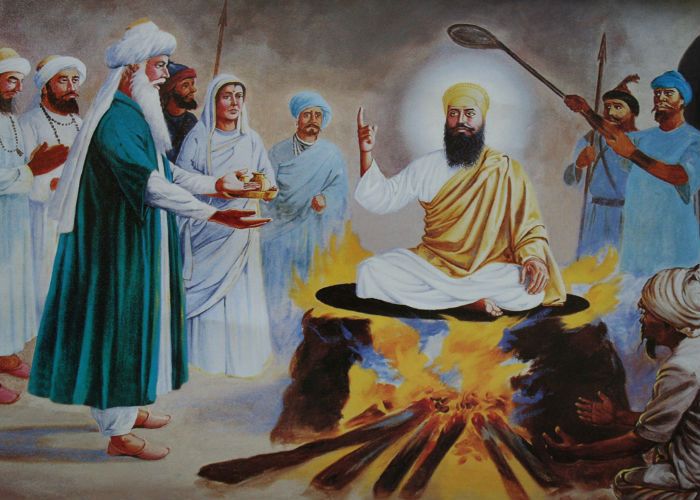
The most beautiful part of the story is how Guru Arjan is deemed to have sung this shabad before his torturous death at the behest of Emperor Jahangir.  


ਆਸਾ ਘਰੁ ੭ ਮਹਲਾ ੫ ॥
आसा घरु ७ महला ५ ॥
Āsā gẖar 7 mėhlā 5.
Aasaa, Seventh House, Fifth Mehl:

ਹਰਿ ਕਾ ਨਾਮੁ ਰਿਦੈ ਨਿਤ ਧਿਆਈ ॥
हरि का नामु रिदै नित धिआई ॥
Har kā nām riḏai niṯ ḏẖiāī.
Meditate continually on the Name of the Lord within your heart.

ਸੰਗੀ ਸਾਥੀ ਸਗਲ ਤਰਾਂਈ ॥੧॥
संगी साथी सगल तरांई ॥१॥
Sangī sāthī sagal ṯarāʼnī. ||1||
Thus you shall save all your companions and associates. ||1||

ਗੁਰੁ ਮੇਰੈ ਸੰਗਿ ਸਦਾ ਹੈ ਨਾਲੇ ॥
गुरु मेरै संगि सदा है नाले ॥
Gur merai sang saḏā hai nāle.
My Guru is always with me, near at hand.

ਸਿਮਰਿ ਸਿਮਰਿ ਤਿਸੁ ਸਦਾ ਸਮ੍ਹ੍ਹਾਲੇ ॥੧॥ ਰਹਾਉ ॥
सिमरि सिमरि तिसु सदा सम्हाले ॥१॥ रहाउ ॥
Simar simar ṯis saḏā samĥāle. ||1|| rahāo.
Meditating, meditating in remembrance on Him, I cherish Him forever. ||1||Pause||

ਤੇਰਾ ਕੀਆ ਮੀਠਾ ਲਾਗੈ ॥ 
तेरा कीआ मीठा लागै ॥ 
Ŧerā kīā mīṯẖā lāgai. 
Your actions seem so sweet to me. 

ਹਰਿ ਨਾਮੁ ਪਦਾਰਥੁ ਨਾਨਕੁ ਮਾਂਗੈ ॥੨॥੪੨॥੯੩॥ 
हरि नामु पदारथु नानकु मांगै ॥२॥४२॥९३॥ 
Har nām paḏārath Nānak māʼngai. ||2||42||93|| 
Nanak begs for the treasure of the Naam, the Name of the Lord. ||2||42||93|| 

The Martyrdom of Guru Arjan

By Kishori Lal

There may not be more harrowing examples in the history of world of killing persons mercilessly, who thought differently from the rulers of their times, by perpetrating multiple tortures, than ruthless Mugal emperor Jahangir,  who brutally ended the life of Sikh saint and 5th Guru of Sikhs, Arjan Dev.

Born on April 15, 1563, at Goindwal Saheb, he was the youngest son of Guru Ram Das. He was a great visionary Guru who started the construction of Golden Temple. Interestingly his Muslim devotee had laid the foundation of the holy shrine. He also completed the Nectar Sarovar and Harmandir Sahib in 1604. He was an ardent preacher of universal brotherhood, forgiveness, humility and freedom of worship.

Guru Arjan Dev compiled the Adi-Granth, Guru Granth Saheb up to his time in which in added many writings of Muslim and Hindu saints.

Irked by his popularity, Mugal emperor Jahangir summoned him and tried to prevail upon him to accept Islam. He was asked to embrace Islam to escape death. He preferred martyrdom.

On the fateful day of June 16, 1606, the tyrant Jahangir ordered the arrest of Guru Arjan Dev and punished him with death. The manner in which he was killed has no parallel in the history.  The only charge against him was that he had refused to stop the preachings of Guru Nanak Dev of worshipping God.

On the first day of persecution, he was starved and not a drop of water was given. In the previous night he was kept awake and made to sit on a red-hot thick iron sheet and red hot sand was poured on his head and body.

The brutal ruler was intrigued and shocked to observe that Guru Arjan Dev bore the brunt of pain calmly without showing any shriek of pain. He kept on murmuring the name of God and chanting the verses from the holy book Granth Sahib. One Chandu, a villain and traitor, was doing it to please the king.

On the second day, Chandu directed Guru ji to sit on a large copper caldron of boiling water. Guru sat silently on the boiling caldron without showing any sign of pain.  He only said, “My lord, all this is happening in accordance with thy will, which is very sweet to me.”

On the third day of torture, again red hot sand was poured on his head and body. On the fourth day of torture, he was again asked to sit on the red hot thick iron plate and was subjected to suffocation on the fifth day. Thousands of his weeping followers watched the ghastly scene helplessly and desperately.

Then the solders of Jahangir took Guru Arjan Dev to river Beas on the sixth day for a bath where he entered it never to come back.

During the course of torture, his Muslim devotee, Mian Amir, rushed to Arjan Dev, to see his plight. It was believed at that time that Amir possessed supernatural powers.  Seeing his horible condition, he cried out, “ Master,  I cannot bear the horrors inflicted on you. Allow me to demolish this tyrant regime.” Guru smiled and ordained him to look at the sky. It is said that he saw the angels in the sky begging for the permission to destroy the tyrannical and ruthless regime of Jahangir.

It may not be out of place to reproduce briefly some lines from the diary of Jahangir, “Tuzuk-i-Jahangir” to analyse  mental perversity of the Mughal emperor who broke all records of cruelty and barbarity in known history.  He wrote, “There lived a Hindu Arjan, an insignificant man, dressed in garments of sainthood and sanctity. He had captured simple-hearted Hindus and even ignorant and foolish followers of Islam who loudly beat the drums of his holiness. Stupid people crowded him to worship and manifest faith in him.  Four generations of spiritual Sikh successors had kept his shop warm.  It occurred to me to put a stop to it and bring him round to the fold of Islam….”

He has also mentioned in his personal diary that once Khusrau passed from the hermit of Guru Arjan Dev, who was widely adored and loved by people of all religions and faiths. He halted there to pay obeisance to Guruji and seek his blessings. Guru put a saffron finger sign (Tilak) on his forehead. I was furious to learn it.  “ I ordered to produce him before me and directed to forfeit all his property and put him to death.”

Guru Arjan Dev and Mian Mir: A Tale of Love and Friendship between two Sufi masters

by Navid Zaidi

Guru Arjan Dev (1563-1606) was the fifth Guru of the Sikh faith that flourished in the Punjab region of India from the sixteenth century onwards.

Hazrat Mian Mir (1550-1635) was a famous Muslim Sufi saint who resided in and around the city of Lahore in the Punjab. Both men became life-long friends and devotees and their love and friendship glorifies the Sufi doctrine of love for all.

The period of the fifth Guru Arjan Dev is important for many reasons. First, it was Guru Arjan who arranged for the Garanth Saheb to be recorded and it became a Sikh holy scripture of great symbolic power. Secondly, Mughal hostility and persecution became evident during his time.

The Mughals, particularly Emperors Jahangir and Aurangzeb, persecuted the non-believers for political and religious reasons. In fact, not only Hindus and Sikhs but also Shia Muslims and Sufi saints became their victims.

The Sikh faith boldly declared equality and justice for all at a time when the Punjab was engulfed by extreme religious and social hatred, intolerance and inequality among various faiths, castes and creeds. Said Guru Gobind Singh:

Recognize all mankind, whether Hindus or Muslims, as one,
The same Lord is the Creator and Nourisher of all,
Recognize no distinction among them,
The temple and the mosque, the Hindu and Muslim prayer,
Men are all one.

This message of tolerance and religious co-existence was well received by the masses especially the Muslim Sufi saints of the Punjab.

Guru Arjan Dev often visited Lahore, the birthplace of his father, the fourth Guru Ram Das. On the occasion of one such visit he called on Hazrat Mian Mir and the two Sufi masters met and became life-long friends. Mian Mir was 13 years older than Guru Arjan.

Mian Mir was highly respected by the Sikhs. He was a man who had a deep love for Guru Nanak’s teachings. Mian Mir often traveled to Amritsar to meet with Guru Arjan. In turn, whenever Guru Arjan visited Lahore he would always meet with Mian Mir. Main Mir knew a large number of Guru Arjan’s verses by heart.

In 1588, Guru Arjan Dev planned to build a temple in Amritsar, now known as the Golden Temple. The temple was to be open to people of all castes and creeds. The Hindu temples were closed on three sides and their entrances were generally towards the East while Muslim mosques had entrances towards the West. The Sikh temples had entrances on all four sides denoting that God was in all directions and that the Gurudwara was open to all.

Guru Arjan invited Mian Mir to lay the foundation stone of the Golden Temple. Mian Mir was given a customary warm welcome. The two masters embraced each other in sincere love and regard. Mian Mir was delighted with Guru Arjan’s ideas, the foundation stone was laid, hymns were sung in the praise of God and sweets were distributed.

The Mughals were getting uneasy with Guru Arjan’s popularity with the masses. In 1606, Guru Arjan Dev was charged by Emperor Jahangir with heresy and support of Prince Khusrow, his son, in the struggle for the throne. Emperor Akbar was unhappy with Jahangir and had designated his grandson Khusrow as his preferred choice for the Mughal throne.

Guru Arjan was imprisoned in Lahore Fort and tortured. When Mian Mir heard about it, he went to see Guru Arjan. Mian Mir was deeply saddened to see his friend in such misery, but he found Guru Arjan calm and serene, having completely resigned himself to the will of God.

Mian Mir suggested to the Guru that he should intercede with Emperor Jahangir on his behalf. The Guru forbade him. Then Mian Mir sought the Guru’s approval to raze the city of Delhi down to the ground with his spiritual powers. Guru Arjan replied:

‘I can also do that but under all conditions one must live in the will of God.’

Guru Arjan Dev was tortured to death in 1606 and became the first martyr of the Sikh faith. Mian Mir raised slogans to mourn the martyrdom of Guru Arjan. He never accepted any gifts sent by Emperors Jahangir and Shah Jahan or their ministers and nobles.

A couple of years after the martyrdom of Guru Arjan, his son and successor Guru Har Gobind, then a boy of 13, called on Mian Mir at Lahore. Guru Tegh Bahadur, the ninth Guru, also met Mian Mir as a child who blessed him.


The story of Guru Arjan's Martyrdom in Hindi


गुरु अर्जुन देव जी की शहादत अतुलनीय है। मानवता के सच्चे सेवक, धर्म के रक्षक, शांत और गंभीर स्वभाव के स्वामी गुरु अर्जुन देव अपने युग के सर्वमान्य लोकनायक थे जो दिन-रात संगत की सेवा में लगे रहते थे। उनके मन में सभी धर्मों के प्रति अथाह सम्मान था। श्री गुरु अर्जुन देव जी के बाद गुरु हरगोबिंद साहिब ने शांति के साथ-साथ हथियारबंद सेना तैयार करनी बेहतर समझी तथा मीरी-पीरी का संकल्प देते हुए श्री अकाल तख्त साहिब की रचना की।


गुरु अर्जुन देव जी ने गुरु ग्रंथ साहिब का संपादन भाई गुरदास की सहायता से किया और रागों के आधार पर ग्रंथ साहिब में संकलित बाणियों का जो वर्गीकरण किया है, उसकी मिसाल मध्यकालीन धार्मिक ग्रंथों में दुर्लभ है। सिख धर्म में सबसे पहली शहीदी पांचवें सिख गुरु अर्जुन देव जी की हुई। शांति के पुंज, शहीदों के सरताज, अर्जुन देव जी को मुगल बादशाह जहांगीर ने अकारण ही शहीद कर दिया। अकेला शहीद ही नहीं किया, बल्कि गुरु जी को ऐसी यातनाएं दीं कि सुनकर रूह कांप जाती है। ये यातनाएं अमानवीय थीं। विश्व को ‘सरबत दा भला’ का संदेश देने वाले तथा विश्व में शांति लाने की पहल करने वाले किसी गुरु को यातनाएं देकर शहीद कर देना मुगल साम्राज्य के पतन का भी कारण बना।

श्री गुरु अर्जुन देव जी का प्रकाश श्री गुरु रामदास जी के गृह में माता भानी जी की कोख से वैशाख बदि 7 सम्वत 1620 मुताबिक 15 अप्रैल 1563 ई. को गोइंदवाल साहिब में हुआ। आप जी का पालन-पोषण गुरु अमरदास जी जैसे गुरु तथा बाबा बुड्ढा जी जैसे महापुरुषों की देख-रेख में हुआ। आप जी बचपन से ही बहुत शांत स्वभाव तथा पूजा भक्ति करने वाले थे। आपके बाल्यकाल में ही गुरु अमरदास जी ने भविष्यवाणी की थी कि यह बालक बहुत बाणी की रचना करेगा। गुरु जी ने कहा था ‘दोहता बाणी का बोहेथा’।

गुरु गद्दी संभालने के बाद गुरु अर्जुन देव जी ने लोक भलाई तथा धर्म प्रचार के कामों में तेजी ला दी। आपने गुरु रामदास जी द्वारा शुरू किए गए सांझे निर्माण कार्यों को प्राथमिकता दी। नगर अमृतसर में आपने संतोखसर तथा अमृत सरोवरों का काम मुकम्मल करवा कर अमृत सरोवर के बीच हरिमंदिर साहिब जी का निर्माण कराया, जिसका शिलान्यास मुसलमान फकीर साईं मियां मीर जी से करवा कर धर्मनिरपेक्षता का सबूत दिया और अमृतसर शहर आस्था का केन्द्र बन गया। आप जी ने नए नगर तरनतारन साहिब, करतारपुर साहिब, छेहर्टा साहिब, श्री हरगोबिंदपुरा आदि बसाए। तरनतारन साहिब में एक विशाल सरोवर का निर्माण कराया जिसके एक तरफ तो गुरुद्वारा साहिब और दूसरी तरफ कुष्ठ रोगियों के लिए एक दवाखाना बनवाया। यह दवाखाना आज तक सुचारू रूप से चल रहा है। सामाजिक कार्य के रूप में गांव-गांव में कुंओं का निर्माण कराया। सुखमणि साहिब की भी रचना की जिसका हर गुरसिख प्रतिदिन पाठ करता है।


गुरु अर्जुन देव जी ने गुरु ग्रंथ साहिब का संपादन भाई गुरदास की सहायता से किया और रागों के आधार पर ग्रंथ साहिब में संकलित बाणियों का जो वर्गीकरण किया है, उसकी मिसाल मध्यकालीन धार्मिक ग्रंथों में दुर्लभ है। गुरु जी ने सदैव ही अपने सिखों को परमात्मा पर हर समय भरोसा रखने तथा सर्व सांझीवालता का संदेश दिया। एक बार सुलही खान, जो मुगल राजा था, गुरु जी पर चढ़ाई करने आ गया। जब संगत को इसके बारे में पता चला तो उन्होंने गुरु जी को कहा कि कोई पत्र लिखकर सुलही खान को भेजा जाए, जिसमें उसे हमला न करने की सलाह दी गई हो। कुछ लोगों का कहना था कि एक प्रतिनिधिमंडल भेजा जाए, जो उसे सिख धर्म के बारे में बता सके तथा हमला न करने संबंधी राजी कर सके जबकि कुछ अन्य लोगों का कहना था कि सुलही खान का मुकाबला करने के लिए हमें कोई न कोई उपाय करना चाहिए। गुरु अर्जुन देव जी ने उन्हें समझाते हुए कहा कि उन्हें परमेश्वर पर पूर्ण विश्वास है। इस संबंध में आप जी का उच्चारण किया हुआ एक शब्द भी गुरु ग्रंथ साहिब में दर्ज है।

अकबर की सम्वत 1662 में हुई मौत के बाद उसका पुत्र जहांगीर बादशाह बना तो गुरु जी के भाई पृथ्वी चंद ने उससे नजदीकियां बढ़ानी शुरू कर दीं। जहांगीर गुरु जी की बढ़ती लोकप्रियता को पसंद नहीं करता था। उसे यह बात बिल्कुल पसंद नहीं आई कि गुरु अर्जुन देव जी ने उसके भाई खुसरो की मदद क्यों की। जहांगीर ने अपनी जीवनी ‘तुज़के जहांगीरी’ में स्वयं भी लिखा है कि वह गुरु अर्जुन देव जी की बढ़ रही लोकप्रियता से आहत था, इसलिए उसने गुरु जी को शहीद करने का फैसला कर लिया।

गुरु अर्जुन देव जी को लाहौर में 30 मई 1606 ई. को भीषण गर्मी के दौरान ‘यासा व सियास्त’ कानून के तहत लोहे की गर्म तवी पर बिठाकर शहीद कर दिया गया। ‘यासा व सियास्त’ के अनुसार किसी व्यक्ति का रक्त धरती पर गिराए बिना उसे यातनाएं देकर शहीद कर दिया जाता है। गुरु जी के शीश पर गर्म-गर्म रेत डाली गई। जब गुरु जी का शरीर अग्नि के कारण बुरी तरह से जल गया तो आप जी को ठंडे पानी वाले रावी दरिया में नहाने के लिए भेजा गया, जहां गुरु जी का पावन शरीर आलोप हो गया। जहां आप ज्योति ज्योत समाए उसी स्थान पर लाहौर में रावी नदी के किनारे गुरुद्वारा डेरा साहिब (जो अब पाकिस्तान में है) का निर्माण किया गया है।


गुरु अर्जुन देव जी ने लोगों को विनम्र रहने का संदेश दिया। आप विनम्रता के पुंज थे। कभी भी आपने किसी को भी दुर्वचन नहीं बोले। गुरु अर्जुन देव जी का संगत को एक और बड़ा संदेश था कि परमेश्वर की रजा में राजी रहना। जब आपको जहांगीर के आदेश पर आग के समान तप रही तवी पर बिठा दिया, उस समय भी आप परमेश्वर का शुक्राना कर रहे थे:

‘तेरा कीया मीठा लागै॥ हरि नामु पदार्थ नानक मांगै॥’

Other Shabads With This Theme

Bhinni Rainariye
Meetha Meetha - Tera Kiya Meetha Lagai - Guru Arjan
Kẖūb ṯerī pagrī mīṯẖe ṯere bol - Bhagat Namdev
Naanak Naam Mahaa Ras Meetha
Amrit Bani Har Har Teri
Maḏẖur maḏẖur ḏẖun anhaṯ gājai - Bhagat Namdev
Sabhai Ghat Raam Bolai - Bhagat Namdev
Jogī kahėh jog bẖal mīṯẖā 
Hamari Pyaari Amritdhaari
Kali Koyal Tu Kit Gun Kali
Mithbolrha ji Har Sajjan Swami 
Loga bharam na Bhoolo bhai (Gur gud deena meetha) - Kabir
Bābā bolīai paṯ hoe - Guru Nanak

Other "Sweet" references
Just a spoonful of sugar helps the medicine go down - Song from Mary Poppins
Bhai Nandlal - Sack of Sugar
Joyful acceptance - Michael J Fox - How Michael J. Fox accepted his alzheimer's. 


Ham to hain pardes main 

A Ghazal by Dr. Rahi Masoom Raza 

ham to haiñ pardes meñ des meñ niklā hogā chāñd 
apnī raat kī chhat par kitnā tanhā hogā chāñd 

jin āñkhoñ meñ kājal ban kar tairī kaalī raat 
un āñkhoñ meñ aañsū kā ik qatra hogā chāñd 

raat ne aisā peñch lagāyā TuuTī haath se Dor 
āñgan vaale niim meñ jā kar aTkā hogā chāñd 

chāñd binā har din yuuñ biitā jaise yug biite 
mere binā kis haal meñ hogā kaisā hogā chāñd 


हम तो हैं परदेस में, देस में निकला होगा चाँद
अपनी रात की छत पर कितना तनहा होगा चाँद

जिन आँखों में काजल बन कर तैरी काली रात
उन आँखों में आँसू का इक क़तरा होगा चाँद

रात ने ऐसा पेंच लगाया टूटी हाथ से डोर
आँगन वाले नीम में जाकर अटका होगा चाँद

चाँद बिना हर दिन यूँ बीता जैसे युग  बीते
मेरे बिना किस हाल में होगा कैसा होगा चाँद

-राही मासूम रज़ा

Translation from http://songtranslationsbyme.blogspot.com/2011/04/hum-to-hain-pardes-mein-originally.html


I am away from home,
Overseas all alone.
A silver moon must have risen
Like a radiant bride
Over my countryside.
Standing all alone
On the dark roof forlorn
Of an ink blue night.

Staying away from my moon
Each day passes as if eons.
Wonder how he has fared without me.
I hope my moon is alright
Standing all alone
On the dark roof forlorn
Of an ink blue night.

The night would plot a conspiracy.
The kite string would break free.
The kite-like moon would be stuck on the Neem tree,
Growing on my courtyard’s boundary.

Those eyes smeared dark
with the kohl of the night,
The moon would be but a spark,
A teardrop in their fading light.

I am away from home
Overseas all alone.
A silver moon must have risen
Like a radiant bride
Over my countryside.

P.S: 'The moon' is a term often used for a beloved. In this poem too the physical moon often interchanges with the poet's loved one.
Newer Posts Older Posts Home

SHIVPREET SINGH

Singing oneness!
- Shivpreet Singh

Related Posts

Popular - 30 days

  • Vande Mataram - Lyrics and Translation
    I love the Vande Maataram composition in Raag Des sung by Lata Mangeshkar.  Vande Mataram is the national song of India. In 2003, BBC World ...
  • Kabir's Gao Gao Ri Dulhani - Lyrics and meanings
    One of my favorite Kabir's poem I call "Dulhani." In this beautiful poem, Kabir envisions himself as the bride and the univers...
  • The Many Types of Raag Malhar
    Pour love in your heart, like the rain pours on the land today. As I am working on a Meerabai song I am doing research on the different vari...
  • Praising Shri Krishna in the Guru Granth Sahib - Dhan Dhan O Raam Ben by Bhagat Namdev
    I made a new composition for this shabad today. Hopefully I will get to record it one day. I'd like to focus our discussion on this part...
  • Sanson Ki Mala Pe - Lyrics, Translation and Background
    Sanson ki Maala was made famous by Nusrat Fateh Ali Khan sahib.  Although some have attributed this song to Mirabai and Khusro, this is a gh...
  • Jindari Lutti by Ghulam Farid - Lyrics/Translation and Performance by Bade Ghulam Ali Khan (Also Rohi or Dilri Lutti)
    Bade Ghulam Ali Khan's version of this Multani Kafi This is a beautiful spiritual song of separation written by Ghulam Farid.  I recentl...
  • Shunya Gadh Shehar - Gorakhnath Bhajan Composed by Pt. Kumar Gandharva
    Listening to this beautiful bhajan today by Pt. Kumar Gandharva.  I don't know if this is authentically by Gorakhnath, but it made me th...
  • Samrath Guru - Video and Translation
    Sometime last year I heard this haunting melody from Nirinjan Kaur ... and fell in love with it. Since then I have been singing it and recor...
  • Loving in the night - a poem by Rabi'a
    [O my Lord] by rabi'A Translated by Jane hirshfield O my Lord, the stars glitter and the eyes of men are closed. Kings have locked their...
  • Love and the Mool Mantra
    Guru Nanak's teachings are undoubtedly about love. So are Guru Arjan's teachings. The Mool Mantra is given the highest importance i...

Blog Archive

  • ▼  2026 (12)
    • ▼  June (1)
      • Translation of Laavan - Shivpreet Singh
    • ►  May (1)
    • ►  April (1)
    • ►  March (6)
    • ►  February (1)
    • ►  January (2)
  • ►  2025 (24)
    • ►  October (5)
    • ►  September (7)
    • ►  August (2)
    • ►  July (2)
    • ►  June (3)
    • ►  March (1)
    • ►  February (2)
    • ►  January (2)
  • ►  2024 (21)
    • ►  December (1)
    • ►  November (2)
    • ►  October (3)
    • ►  September (2)
    • ►  August (4)
    • ►  July (2)
    • ►  June (3)
    • ►  May (1)
    • ►  April (1)
    • ►  February (1)
    • ►  January (1)
  • ►  2023 (41)
    • ►  December (4)
    • ►  November (3)
    • ►  October (4)
    • ►  September (7)
    • ►  August (5)
    • ►  July (7)
    • ►  June (3)
    • ►  May (3)
    • ►  April (1)
    • ►  March (1)
    • ►  February (3)
  • ►  2022 (8)
    • ►  March (2)
    • ►  January (6)
  • ►  2021 (139)
    • ►  December (15)
    • ►  November (2)
    • ►  October (6)
    • ►  September (7)
    • ►  August (2)
    • ►  July (4)
    • ►  May (21)
    • ►  April (21)
    • ►  March (35)
    • ►  February (23)
    • ►  January (3)
  • ►  2020 (150)
    • ►  December (2)
    • ►  November (13)
    • ►  October (32)
    • ►  September (47)
    • ►  August (37)
    • ►  July (5)
    • ►  June (3)
    • ►  May (3)
    • ►  April (3)
    • ►  March (2)
    • ►  February (1)
    • ►  January (2)
  • ►  2019 (43)
    • ►  December (5)
    • ►  November (8)
    • ►  October (13)
    • ►  September (4)
    • ►  July (3)
    • ►  June (1)
    • ►  May (2)
    • ►  March (1)
    • ►  February (1)
    • ►  January (5)
  • ►  2018 (53)
    • ►  December (8)
    • ►  November (5)
    • ►  October (3)
    • ►  September (4)
    • ►  August (6)
    • ►  July (3)
    • ►  June (4)
    • ►  May (6)
    • ►  April (5)
    • ►  March (2)
    • ►  February (4)
    • ►  January (3)
  • ►  2017 (73)
    • ►  December (2)
    • ►  November (12)
    • ►  October (8)
    • ►  September (1)
    • ►  August (7)
    • ►  July (6)
    • ►  June (12)
    • ►  May (5)
    • ►  April (4)
    • ►  March (8)
    • ►  February (3)
    • ►  January (5)
  • ►  2016 (141)
    • ►  December (1)
    • ►  November (9)
    • ►  October (16)
    • ►  September (19)
    • ►  August (2)
    • ►  July (5)
    • ►  June (7)
    • ►  May (3)
    • ►  April (18)
    • ►  March (34)
    • ►  February (16)
    • ►  January (11)
  • ►  2015 (28)
    • ►  December (1)
    • ►  November (1)
    • ►  October (2)
    • ►  September (12)
    • ►  August (1)
    • ►  May (1)
    • ►  April (7)
    • ►  March (1)
    • ►  February (1)
    • ►  January (1)
  • ►  2014 (107)
    • ►  December (1)
    • ►  November (6)
    • ►  October (1)
    • ►  August (2)
    • ►  July (1)
    • ►  June (11)
    • ►  April (10)
    • ►  March (15)
    • ►  February (24)
    • ►  January (36)
  • ►  2013 (242)
    • ►  December (13)
    • ►  October (5)
    • ►  September (3)
    • ►  August (3)
    • ►  June (7)
    • ►  May (62)
    • ►  April (79)
    • ►  March (12)
    • ►  February (23)
    • ►  January (35)
  • ►  2012 (145)
    • ►  December (29)
    • ►  November (31)
    • ►  October (44)
    • ►  September (5)
    • ►  August (9)
    • ►  July (7)
    • ►  June (1)
    • ►  May (3)
    • ►  April (1)
    • ►  March (4)
    • ►  February (9)
    • ►  January (2)
  • ►  2011 (252)
    • ►  December (1)
    • ►  November (1)
    • ►  October (4)
    • ►  September (13)
    • ►  August (28)
    • ►  July (44)
    • ►  June (33)
    • ►  May (15)
    • ►  April (2)
    • ►  March (45)
    • ►  February (43)
    • ►  January (23)
  • ►  2010 (70)
    • ►  December (31)
    • ►  November (20)
    • ►  October (2)
    • ►  September (3)
    • ►  August (1)
    • ►  July (2)
    • ►  May (5)
    • ►  March (4)
    • ►  February (1)
    • ►  January (1)
  • ►  2009 (15)
    • ►  December (1)
    • ►  November (3)
    • ►  October (2)
    • ►  September (2)
    • ►  August (1)
    • ►  June (1)
    • ►  April (1)
    • ►  March (1)
    • ►  February (1)
    • ►  January (2)
  • ►  2008 (15)
    • ►  November (1)
    • ►  July (2)
    • ►  June (5)
    • ►  May (1)
    • ►  April (2)
    • ►  March (1)
    • ►  February (1)
    • ►  January (2)
  • ►  2007 (9)
    • ►  November (4)
    • ►  October (2)
    • ►  September (1)
    • ►  August (2)
  • ►  1999 (1)
    • ►  May (1)

Message

Name

Email *

Message *

Twitter

Tweets by @shivpreetsingh


Copyright © Shivpreet Singh. Designed by OddThemes