Namdev
By
Sri Swami Sivananda
Introduction
Namdev of Maharashtra was a saint of mediaeval India.
Namdev was a contemporary of Jnanadev, the famous saint of Maharashtra, being his senior in age by about five years. He was born in 1269 A.D. He came of a family of tailors who were sincere devotees of Vittala of Pandharpur. The family members were observing the Wari of Pandharpur, i.e., going on pilgrimage twice a year on the first eleventh day of the Ashadh (June-July) and Kartik (October-November) months. The family originated from a village called Narsibamani on the bank of the river Krishna, near Karad, in district Satara. Being a great devotee of Vittala and wishing to improve his material prospects, Dama Setti, the father of Namdev, had moved to Pandharpur a year or two before his son’s birth.
Namdev, from his very childhood; was like Prahlad. At the age of two, when he began to talk, the first correct word he uttered was ‘Vittala’, and since then, he continued with the repetition of that sacred name incessantly, without any help or instruction from others. He found great pleasure when every day his mother Guna Bai took him to the temple of Vithoba for offering worship to the Deity. His next step was, when at the age of about seven, he prepared a pair of cymbals and spent his time in dancing and singing, doing Bhajan, to the neglect of everything—food, studies in school, rest, sleep, etc. His devotion to Vithoba was so innocent and sincere that he used to treat Him sometimes as his dearest brother or as his playmate.
One day, as Namdev’s mother was busy, she asked Namdev to take the plate of offerings to Vithoba. Namdev went to the temple, placed the plate of eatables before Vithoba and asked Him to accept the offering. However, when Namdev did not find any evidence of acceptance by Vithoba, he cried so bitterly that Vithoba actually assumed a human form and accepted the offerings gratefully. Namdev’s mother was surprised when her son came back in great joy with an empty plate and explained to her that Vithoba had accepted the offerings by actually consuming the eatables presented in the plate. So, the next day, she herself accompanied Namdev (but without his knowledge) to see and verify for herself the correctness of Namdev’s explanation. The same performance was repeated and the mother had the satisfaction of seeing the Lord actually accepting their offerings. Her joy and pride in Namdev was unbounded. She felt grateful to the Lord that she was the mother of such a great devotee.
Lord Vithoba—his only interest
In other respects, however, Namdev was the despair of his parents, and later, of his wife and other relatives. From the beginning he had no interest in worldly affairs; he neglected studies in school; he would not take interest in his father’s profession as a tailor, or in any other trade. His sole interest was to spend day and night in devotion to Vithoba. His parents were getting old; the family prosperity was waning. Therefore, their dearest wish was that Namdev, while devoting a reasonable spare time to his devotions, should help in maintaining the family in comfort. So, Namdev was sent to the bazaar one day to sell a few pieces of clothes.
But Namdev was innocent of the tricks of the trade. To him, such things as prices, and money and its value, were unknown subjects. He went to the bazaar with the clothes, because his father forced him. He sat there on a stone doing Bhajan, entirely forgetting that he had gone there to sell the clothes. After a few hours the sun set and it was time for him to go to the temple for the evening devotional performance. Then only he remembered that he had not sold the clothes and that he would get a thrashing from his father. He was impatient to go to the temple. He therefore sold all the clothes to the very stone on which he was seated, i.e., he kept the clothes on the stone, appointed another stone as a guarantee that the first one would pay the money the next day, and went to the temple.
Namdev’s father was furious on hearing his son’s adventures and asked him to bring forth Dhondya (which means a stone and which is also used as a proper name among certain classes of people of Maharashtra) who had guaranteed the money. The next day Namdev went back to the bazaar, found that the clothes had vanished during the night and took the second stone (Dhondya) home, as it refused to pay the money, and locked it in a room. He then went to the temple and narrated all the events to Vithoba and explained his difficulties also. When Namdev’s father asked him to show him Dhondya who had guaranteed the money, Namdev replied that Dhondya had been kept in a closed room in the house and ran to the temple. When the father opened the room to demand the money, he found, to his surprise, a lump of gold. Great was the father’s joy; but Namdev was quite indifferent to it. He only praised God for saving him from a thrashing. Thus it went on.
His marriage
In the meantime, Namdev married Radha Bai. Radha Bai was a worldly-minded woman. In response to Namdev’s invitation, Vittal attended the naming ceremony of Namdev’s child in the guise of a human being, named the child ‘Narayana’ and gave good gifts on the occasion.
There was extreme poverty in the house of Namdev. Namdev neglected his worldly duties. Namdev’s mother and wife abused Lord Krishna. Under the guise of Dharma Setti of Vaikunthapuram and the pretence of past friendship with Namdev, the Lord visited Namdev’s house, gave magnificent gifts to Radha Bai and disappeared.
A Bhakta, named Parisha Bhagavat, propitiated Rukmini and got the philosopher’s stone which could convert iron into gold. Parisha’s wife gave the stone to her friend Radha Bai one day. Radha Bai showed the stone to her husband and said that his Bhakti was of no use and was inferior to the Bhakti of Parisha Bhagavat. Namdev threw the stone into the river. Next day Parisha came to know of everything and took Namdev to task. Namdev showed Parisha the place where he had dropped the stone. Parisha searched for the stone and found, not a single stone, but a whole lot. Parisha was struck with wonder. He admired the spirit of renunciation and the spiritual powers of Namdev.
Namdev felt it increasingly difficult to take interest in household affairs and in his parents, wife and children; and no amount of persuasion from all those people or his friends was successful in bringing him back to the worldly life. To him there was only one interest and that was Lord Vithoba. He used to spend hour after hour sitting before Vithoba, talking to Him, discussing spiritual matters with Him and doing Bhajan. To Namdev, Vithoba was the beginning and the end of everything.
Meeting with Jnanadev
When Namdev was about twenty years of age, he met the great saint Jnanadev at Pandharpur. Jnanadev was naturally attracted to Namdev as a great devotee of Vithoba. That he might benefit from the company of Namdev, he persuaded Namdev to go with him to all the holy places on pilgrimage. Namdev did not want to go, as that would mean separation from Lord Vithoba of Pandharpur. However, wiser counsel prevailed and Namdev was induced to go on pilgrimage. This was the most important period in the life of Namdev. Practically from this time, the two great saints almost never separated till death parted them. The pilgrimage extended to all parts of India and almost all the holy places.
On the way, several miracles are reported to have been performed by both Namdev and Jnanadev. Once Namdev and Jnanadev reached the desert of Marwar. Namdev was dying of thirst. They found out a well, but the water was at such a low depth that it was impossible to get it by ordinary means. Jnanadev proposed to assume the form of a bird by his Laghima Siddhi and bring the water up in his beak. But Namdev proved superior to him. He prayed to Rukmini. The level of the water rose miraculously to the surface. The well is seen even today at Kaladji, ten miles off Bikaner.
Namdev and Jnanadev came to Naganathpuri. Namdev started Bhajan in the temple. There was a huge crowd. The temple priests were not able to enter the temple and so became angry. Namdev went to the western gate of the temple and spent the night in doing Kirtan. The image of the temple itself turned to his side.
A Brahmin of Bidar invited Namdev to do Bhajan in his house. Namdev went there with a large number of devotees. The Sultan mistook them for rebel troops and sent General Kasi Pant against them. The general reported to the Sultan that it was only a religious party. The Sultan ordered that Namdev should be arrested and prosecuted. He asked Namdev to rouse a butchered cow to life or embrace Islam. An elephant was sent to crush Namdev to death. Namdev’s mother requested her son to embrace Islam to save his life. But Namdev was prepared to die. Namdev raised the dead cow to life. The Sultan and others were struck with amazement. Namdev won the admiration of the Sultan and his party.
Namdev and Jnanadev met Narsi Mehta at Junagarh; Kabir, Kamal and Mudgalacharya at Kashi; Tulsidas at Chitrakut; Pipaji at Ayodhya; Nanak at a place in the Deccan and Dadu, Gorakhnath and Matsyendranath in other places.
When feeding of Brahmins was done by Namdev at the end of his pilgrimage, Vittal and Rukmini became the cooks and servers. They ate out of the very plate which Namdev used.
Namdev gained much, during the pilgrimage, from the society of Jnaneshwar and from Nivritti who was Jnaneshwar’s elder brother and Guru, and was able to look on this world with a wider vision as the manifestation of God.
As we saw earlier, Namdev’s world began and ended with the Deity ‘Vithoba’ of Pandharpur and he would not recognize any other Deity as the symbol of God. The pilgrimage lasted about five years and during this period Jnanadev advised Namdev to adopt a Guru so that he might be in a position to realise completely the manifestation of the all-pervading God and thus fulfil his own mission in life. Again Namdev hesitated as he thought that such action might alienate his loyalty and devotion to Vithoba. He plainly said that as long as he had the love of Vithoba, he had nothing to desire except constant devotion to Him. In fact, Vithoba was his Guru. It was, however, clear to Jnanadev and other saints in the company that Namdev’s view was rather narrow in the sense that he thought God was centred in the Deity of Vithoba of Pandharpur and they wanted him to acquire the wider vision which they themselves had attained.
One day, in such company, Gora, another saint and a potter by trade, was asked to ascertain which of them were half-baked, i.e., had not realised Brahman. Gora took a small, flat wooden board such as he used to prepare or test the pots and began to pat on the head of everybody. When he came to Namdev and patted on his head, Namdev cried aloud thinking he was hurt. Immediately, all the others in the company began to laugh saying that Namdev was only half-baked and had not become fixed in his spiritual position.
Adopting a Guru
Greatly mortified, Namdev repaired to Vithoba and complained to Him of his humiliation. He said that he saw no necessity for him to have a Guru as he had intimate relationship with Lord Krishna Himself. Lord Krishna said that Namdev did not really know Him. Namdev denied this. Lord Krishna challenged Namdev and asked him to find out His identity that day. Namdev agreed. Lord Krishna took the form of a Pathan horseman and passed before Namdev. Namdev could not recognize the Lord. Namdev agreed to go to a Guru. Lord Vithoba then advised him to adopt Visoba Khechar as his Guru.
Visoba Khechar was one of the disciples of Jnanadev and was living at the time at a village called Avandhya. Namdev proceeded to the village immediately and arrived there at about noon. He took shelter in a temple in order to take some rest. There in that temple he saw a man sleeping with his feet on the Deity Itself. Namdev was shocked, woke up the man and rebuked him for this sacrilege. The man was no other than Visoba himself. Visoba replied, “O Namdev, why did you wake me up? Is there a single spot in this world which is not permeated by God? If you think that such a spot can be found, kindly place my feet there”. Namdev took the feet of Visoba in his hands and moved them to another direction, but the Deity was there. He then moved Visoba in still another direction, but the Deity was there too! Namdev could not find any direction or spot where he could place the feet of Visoba without treading on the Deity. God was everywhere. Having realised this great truth that God had permeated the whole universe, Namdev surrendered himself to Visoba gratefully and humbly. Visoba then advised Namdev at great length. A small portion of Visoba’s advice is given below.
“If you want to be absolutely happy, fill this world with Bhajan and the sacred Name of the Lord. The Lord is the world itself. Give up all ambitions or desires. Let them take care of themselves. Be content only with the name of Vittal.
You need not undergo any hardship or penance in order to go to heaven. Vaikuntha will come to you of itself. Do not be anxious of this life or of your friends or relatives. They are like the illusions of a mirage. One has to spend a short space of time here like the potter’s wheel which goes on rotating even after the potter has left. Make the best of it by keeping the name of Vittal ever in your mind and on your lips and by recognizing Him everywhere and in everyone. This is my experience of life.
“Pandharpur was established on the banks of the river Chandrabhaga as a sort of boat for people to cross safely this ocean of life. Pandharinath is standing there as the boatman-in-charge to take you to the other side; and the most important point is that He does this without asking for any fee. In this way He has saved crores of people who have gone to Him in surrender. If you surrender to Him, there is no death in this world.”
After initiation by Visoba, Namdev became more philosophical and large-hearted. His temple was no longer the small narrow space on the banks of the Chandrabhaga, but the whole world. His God was not Vithoba or Vittal with hands and legs, but the omnipotent infinite Being.
A few days after Namdev had adopted Visoba as his Guru, he was sitting at a place doing his Bhajan. In the meantime, a dog came to the spot and ran away with the bread he had prepared for his midday meal. Namdev ran after the dog—not with a stick in his hand, but with a cup of Ghee; and he addressed the dog thus: “O Lord of the world! Why do You want to eat the dry bread? Take some Ghee along with it. It will taste much better”. Namdev’s realisation of Atma was now complete and overflowing.
After Namdev had returned with Jnanadev from the long pilgrimage, the latter expressed his desire to take Samadhi at Alandi. Namdev therefore accompanied the party to Alandi as he could not part with Jnanadev. He was with Jnanadev to the last moment. He then accompanied the party until the other brothers, Nivritti and Sopan, and their sister Muktabai, left the world. Namdev has left behind a detailed account of the ends of these four saints in beautiful poems. Namdev was so shocked by these events which occurred within a short space of one year that he himself was left with no desire to live in this world. He took his Samadhi at Pandharpur at the age of twenty-six in 1295 A.D.
Namdev was not an author of any big treatise; but he left behind him a large number of Abhangas or short poems, full with the nectar of Bhakti and love towards God. These are exceedingly sweet. Most of these are lost, but there are extant about four thousand Abhangas, which to this day are a great source of inspiration to all who would read them. Some of the Abhangas are found in the Sikh Adi Granth.
The essence of Namdev’s message is: “Always recite the Name of the Lord. Constantly remember Him. Hear His glory. Meditate on the Lord in your heart. Serve the Lord with your hands. Place your head at His lotus feet. Do Kirtan. You will forget your hunger and thirst. The Lord will be near you. You will attain immortality and eternal bliss”.
Namdev’s maid-servant Janabai
No account of the life of Namdev would be complete without a mention of Janabai. She was a maid-servant in the household of Namdev. Nothing is known of her life except that she was Namdev’s maid-servant. She herself forgot sometimes that she had an existence apart from being the maid-servant of Namdev. In several poems on devotion which she has left behind, she describes herself as ‘Nam’s maid-servant’ or ‘Namdev’s Jani’. She was one of the closest followers of Namdev and had no ambition other than to serve Namdev and sing the praises of the Lord Vithoba. For instance, in one of her poems she sings:
“Let me undergo as many births in this world as You please, but grant that my desires are fulfilled. They are that I see Pandharpur and serve Namdev in every birth. I do not mind if I am a bird or a swine, a dog or a cat, but my conditions are that in each of these lives, I must see Pandharpur and serve Namdev. This is the ambition of Namdev’s maid.”
In another place, Janabai writes:
“Give me only this girl, O Hari, that I shall always sing Your sacred Name. Fulfil my only desire that You will accept my humble homage and service. This is all that I desire. Have mercy on me and fulfil my desires. I want to concentrate my eyes and mind on You and have Your Name on my lips. For this the maid Jani falls at Your feet.”
That sums up the philosophy of Janabai and how she attained her desired goal. So intense and sincere was her devotion to Vithoba that the Lord Himself used to lighten her household duties, which, as she became old, she found unable to perform. By her service and devotion to God, she completely succeeded in effacing herself and she got completely merged in Him. A great soul—Janabai! And a greater Master—Namdev!


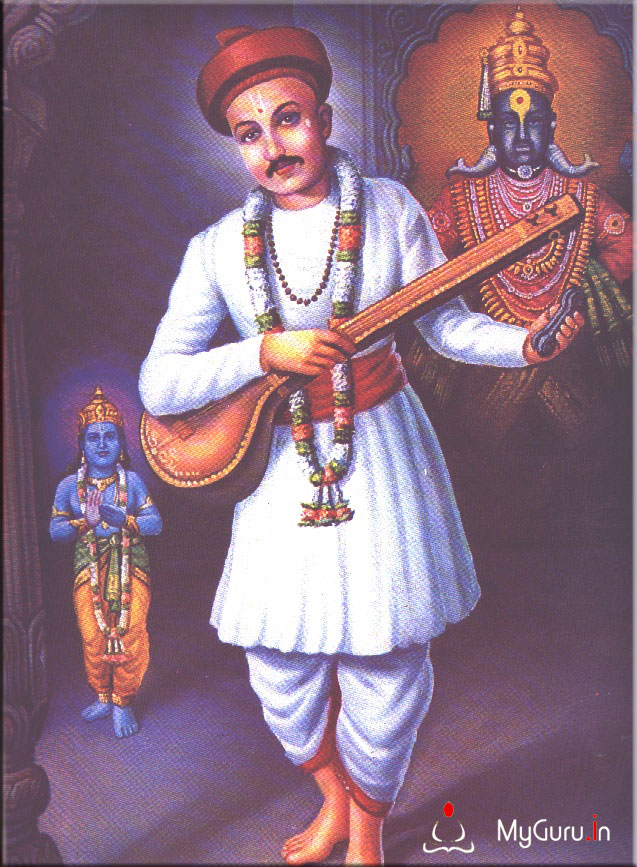
 Singing oneness!


