Turn me around, turn me around
Ain't gonna let nobody turn me around
I'm gonna keep on a-walkin', keep on a-talkin'
Marchin' down to freedom land
Ain't gonna let segregation turn me around
Turn me around, turn me around
Ain't gonna let segregation turn me around
I'm gonna keep on a-walkin', keep on a-talkin'
Marchin' up to freedom's land
Ain't gonna let racism turn me around
Turn me around, turn me around
Ain't gonna let racism turn me around
I'm gonna keep on a-walkin', keep on a-talkin'
Marchin' up to freedom's land
Ain't gonna let no hatred turn me around
Turn me around, turn me around
Ain't gonna let no hatred turn me around
I'm gonna keep on a-walkin', keep on a-talkin'
Marchin' up to freedom's land
Ain't gonna let injustice turn me around
Turn me around, turn me around
Ain't gonna let injustice turn me around
I'm gonna keep on a-walkin', keep on a-talkin'
Marchin' up to freedom's land
Ain't gonna let no jail cell turn me around
Turn me around, turn me around
Ain't gonna let no jail cell turn me around
I'm gonna keep on a-walkin', keep on a-talkin'
Marchin' up to freedom's land
Ain't gonna let nobody turn me around
Turn me around, turn me around
Ain't gonna let nobody turn me around
I'm gonna keep on a-walkin', keep on a-talkin'
Marchin' up to freedom's land
"As it comes to me, I impart the wisdom, O Lalo" - Guru Nanak
Within the now-famous address is what historian Philip S. Foner has called "probably the most moving passage in all of Douglass' speeches."
What, to the American slave, is your 4th of July? I answer; a day that reveals to him, more than all other days in the year, the gross injustice and cruelty to which he is the constant victim. To him, your celebration is a sham; your boasted liberty, an unholy license; your national greatness, swelling vanity; your sound of rejoicing are empty and heartless; your denunciation of tyrants brass fronted impudence; your shout of liberty and equality, hollow mockery; your prayers and hymns, your sermons and thanks-givings, with all your religious parade and solemnity, are to him, mere bombast, fraud, deception, impiety, and hypocrisy -- a thin veil to cover up crimes which would disgrace a nation of savages. There is not a nation on the earth guilty of practices more shocking and bloody than are the people of the United States, at this very hour.
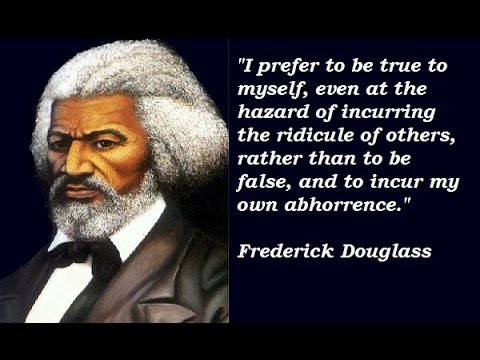
No matter how challenging it may be to articulate the truth, it is essential to vocalize it. Expressing the truth brings people closer to it, as demonstrated when Guru Nanak fearlessly addresses the atrocities of Babur or when Guru Gobind Singh speaks out against similar injustices. A parallel truth is evident in Frederick Douglass's discourse on slavery. In the midst of Abraham Lincoln's era, Douglass, an African American Civil Rights activist, boldly altered his speech during an event on July 5, 1852, originally intended to commemorate the Declaration of Independence, to address the pressing issue of American Slavery.
Within the now-famous address is what historian Philip S. Foner has called "probably the most moving passage in all of Douglass' speeches."
What, to the American slave, is your 4th of July? I answer; a day that reveals to him, more than all other days in the year, the gross injustice and cruelty to which he is the constant victim. To him, your celebration is a sham; your boasted liberty, an unholy license; your national greatness, swelling vanity; your sound of rejoicing are empty and heartless; your denunciation of tyrants brass fronted impudence; your shout of liberty and equality, hollow mockery; your prayers and hymns, your sermons and thanks-givings, with all your religious parade and solemnity, are to him, mere bombast, fraud, deception, impiety, and hypocrisy -- a thin veil to cover up crimes which would disgrace a nation of savages. There is not a nation on the earth guilty of practices more shocking and bloody than are the people of the United States, at this very hour.
I was thinking of rain while practicing the melodic scale of rain, Raag Megh Malhar, and thought to look up what one of my favorite poets had to say about rain and found this beautiful poem: The voice of the rain. Here is the poem followed by my observations on it.
THE VOICE OF THE RAIN.
Walt Whitman
And who art thou? said I to the soft-falling shower,
Which, strange to tell, gave me an answer, as here translated:
I am the Poem of Earth, said the voice of the rain,
Eternal I rise impalpable out of the land and the bottomless sea,
Upward to heaven, whence, vaguely form'd, altogether changed,
and yet the same,
I descend to lave the drouths, atomies, dust-layers of the globe,
And all that in them without me were seeds only, latent, unborn;
And forever, by day and night, I give back life to my own
origin, and make pure and beautify it;
(For song, issuing from its birth-place, after fulfilment, wander-
ing,
Reck'd or unreck'd. duly with love returns.)
A few observations on this poem:
- Rain has never talked to the listener of the poem. It doesn't talk to everyone apparently. In this poem, Walt Whitman asks a question of the rain (Who are you?) and surprisingly, the rain responds. It was a private discussion between Walt and the rain, so he kindly translates for us, the rain-deaf.
- What a beautiful way to describe rain: it is the poem of the earth. Indeed, a poem is what gives life to the world as we know it. A spiritual poem, a guru, gives life to its reciter, its student. If there were no Guru, there would be no enlightenment and thereby no life. Just like if there were no rain, there would be no fresh water, and there would be no life as we know it. Rain gives earth life, literally. So it is indeed the poem of the earth.
- Walt then describes the nature of water: unending, perhaps a poem that is repeated ad infinitum. Water rises from lands and oceans and goes into the sky, and then condenses in the form of rain. In the process it does three things: (1) it gives life back to itself (it can evaporate and condense again), (2) it purifies and cleans everything it touches, and (3) it beautifies it.
[updated 2020]
WHEN MY LOVE SWEARS THAT SHE IS MADE OF TRUTH
By William Shakespeare
When my love swears that she is made of truth,
I do believe her, though I know she lies,
That she might think me some untutored youth,
Unlearnèd in the world's false subtleties.
Thus vainly thinking that she thinks me young,
Although she knows my days are past the best,
Simply I credit her false-speaking tongue:
On both sides thus is simple truth suppressed.
But wherefore says she not she is unjust?
And wherefore say not I that I am old?
Oh, love's best habit is in seeming trust,
And age in love loves not to have years told.
Therefore I lie with her and she with me,
And in our faults by lies we flattered be.
SHIVPREET SINGH
Related Posts
Popular - 30 days
-
I love the Vande Maataram composition in Raag Des sung by Lata Mangeshkar. Vande Mataram is the national song of India. In 2003, BBC World ...
-
One of my favorite Kabir's poem I call "Dulhani." In this beautiful poem, Kabir envisions himself as the bride and the univers...
-
Pour love in your heart, like the rain pours on the land today. As I am working on a Meerabai song I am doing research on the different vari...
-
Bade Ghulam Ali Khan's version of this Multani Kafi This is a beautiful spiritual song of separation written by Ghulam Farid. I recentl...
-
I have recently heard this Bulleh Shah song and it has really touched my heart. Several people have sung it, but I love the original composi...
-
Krishna's Cosmic Flute Playing Bulleh Shah in a kafi says, "You are playing a surprising, wondrous, flute O Krishna." Bulleh S...
-
Bajre Da Sitta is playful and evergreen Punjabi folk song. The song is often sung during long Punjabi weddings. One can imagine that a wom...
-
Exploring the Essence of "Kaar" in Ekonkaar In Sikh philosophy, the term "Ekonkaar" holds profound significance, encapsu...
-
Man Atkeya Beparwah De Naal - Listening and Singing this kaafi by Shah Hussain today ... https://www.youtube.com/watch?v=SkYN2XlK1Vg Raag J...