Shivpreet Singh
Shivpreet Singh
  • Home
  • Music
    • Spotify
    • Apple Music
    • Amazon
    • Pandora
    • SoundCloud
    • Google
    • You Tube
      • Music on YouTube
      • Uplifting Shabads
      • Guru Nanak Shabads
      • Meditation & Chanting
      • Shabads for Kids
      • Shabads of Guru Arjan
      • Shabads of Guru Gobind Singh
  • Videos
    • Latest
    • Popular
    • Uplifting
    • Guru Nanak
    • Meditation
    • For Kids
    • Guru Arjan
    • Guru Gobind Singh
  • Projects
    • DhunAnand Foundation
    • Pandemic 2020
    • Guru Nanak 550
    • Namdev 750
    • Thoughts and Ruminations
    • What I Love to Read
  • News
  • Meet Me
    • Meet Me
    • Request
    • Send Email
    • Newsletter
    • FAQs
  • About
    • Biography
    • Photos
    • Music
    • FAQs

Listening to this today today, and working on a translation:  

Lyrics


Tere ishq ne dera mere andar keeta
Bhar ke zehar pyala, main taan aape peeta
Jhabde wahundi tabiba, nahi te main mar gayaan
Tere ishq nachaaiyaan, kar ke thaiyaa thaiyaa

Chup gaye ve sooraj, bahar reh gayi laali
Ve main sadqe hova, devein murjey vikhali
Peera main bhul gayaan, tere naal na gaiyaan
Tere ishq nachaaiyaan, kar ke thaiyaa thaiyaa

Ais ishq de kolon mainu hatak na maaye
Laahu jaandey berrey, kehrram mor laya
Meri akal jun bhulli, naal mhaniyaan dey gaiyaan
Tere ishq nachaaiyaan, kar ke thaiyaa thaiyaa

Ais ishq di jhangi vich mor bulenda
Sanu qibla ton kaaba, sohna yaar disenda
Saanu ghayal karke, phir khabar na laaiyaan
Tere ishq nachaaiyaan, kar ke thaiyaa thaiyaa

Bullah Shah, na aounda mainu inayat de buhe
Jisne mainu awaye, chole saave te suhe
Jaan main maari aye, addi mil paya hai vahaiya
Tere ishq nachaaiyaan, kar ke thaiyaa thaiyaa


Translation:


Your love has taken up residence within me,
I drank the poisoned chalice with my own hands.
O wandering healer, if you do not come, I will perish—
Your love has spun me into a frenzied dance.

The sun has slipped away, leaving only its crimson glow.
I would give my life for one more glimpse of you.
My wounds were forgotten, but I did not follow when you called—
Your love has spun me into a frenzied dance.

Do not try to turn me away from this path of love.
Can you halt the boats that drift upon the tides?
Foolish, I cast aside my wisdom and followed the boatman—
Your love has spun me into a frenzied dance.

A peacock cries in the wild grove of passion,
For me, my beloved is both Qibla and Kaaba.
You wounded me and never turned back to see—
Your love has spun me into a frenzied dance.

Bulleh Shah lingers at the door of Inayat,
Who clothed me in robes of green and red.
I leaped, but he caught me before I could fly—
Your love has spun me into a frenzied dance.

Poem - 


Counting Notes at Baba Bulleh Shah’s

The singer at Baba Bulleh Shah’s shrine
counts notes in one hand,
sings of love and longing with the other.

It is a delicate balancing act,
like patting your head while rubbing your stomach,
or reading a love letter
while checking the price of wheat.

I wonder if the words—
Tere Ishq nachaaiyaan, kar ke thaiyaa thaiyaa—
are so deeply etched in his heart
that they spill out effortlessly,
the way breath continues
even when we forget to inhale,

or if they are nothing more
than a familiar refrain,
a worn path in the brain,
something to be sung
while the real work of life
is done in the margins.

And at the edge of the night sky,
no stars appear—
or perhaps I cannot count
while desire still flickers.


It is unusual for ghazals to have a central idea, because generally the individual couplets are independent. However, this Mirza Ghalib (like a few others of his), has a central idea.  The central theme of this poem is the transformative power of love and longing. 

The ghazal explores the tension between the ephemeral and the eternal, the tangible and the intangible. The poet uses powerful metaphors to depict the experience of unrequited love and the profound impact it has on the individual. The journey from sigh to longing, from a drop to a pearl, from acknowledgement to becoming ash, all underscore the transformative nature of deep affection and longing. The poet also uses the symbol of "glance" to highlight the powerful impact of love on the lover, capable of both giving life and causing death. The inevitability of life's suffering and the transient nature of existence are also explored, with death positioned as the ultimate release from this cycle. 

The poem beautifully weaves the themes of love, longing, transformation, and mortality into a poignant exploration of human existence.

Aah Ko Chaahiye - Ghazal by Mirza Ghalib


aah ko chaahiye ik umr asar hone tak
kaun jiitaa hai tirii zulf ke sar hone tak

daam-e har mauj mein hai halqah-e sad kaam-e nihang
dekhein kyaa guzre hai qatre pah guhar hone tak

aashiqii sabr-talab aur tamannaa betaab
dil kaa kyaa rang karuun khun-e jigar hone tak

ham ne maanaa kih tagaaful na karoge lekin
khaak ho jaaeinge ham tum ko khabar hone tak

partav-e khur se hai shabnam ko fanaa ki taaliim
main bhii huun ek inaayat kii nazar hone tak

yak nazar besh nahiin fursat-e hastii gaafil
garmii-e bazm hai ik raqs-e sharar hone tak

gam-e hastii kaa asad kis se ho juz marg ilaaj
shamma har rang mein jaltii hai sahar hone tak 

Translation of Aah Ko Chahiye


A sigh might take a lifetime to reveal its effects,
Until then, who will wait to see you untangle your locks?

A hundred dragon mouths weave waves into a net from a single ocean,
Oh, what an endeavor it is for a drop, until it morphs into a pearl.

Love demands patience, but lust knows only restlessness,
Until my heart bleeds to death, what color should it bear?

I know you won't overlook me, yet,
Until you acknowledge me, I would have transformed into ash.

Each bead of dew knows it can evaporate with the sun's rays,
Similarly, I will endure, until you bestow upon me your glance.

Your glances hold the power to cease my life,
As dancing sparks end a jovial gathering, not until the final dance.

Life is an abyss of suffering, Asad, death can provide the cure,
The candle burns in varied hues, not extinguished until the morning's arrival.

I love Walt Whitman for his personal and evocative poetry. He has written several poems where he directly addresses the reader and shows affection from this.  "To You" is one such poem.  Through this poem he celebrates the beauty any reader of his poem.  I find it beautiful that while it may seem he doesn't know the peculiarity of this reader, he connects with their soul.  He still professes his love even though he has not "met" them.  This is the kind of unconditional love of the creation and creator that Kabir talks about when he sings Tu Tu Karta Tu Hua (Saying you you I have become you). 


The poem begins by making the reader walk out of their dream. Guru Tegh Bahadur says, Sagal Jagat hai jaise supna: What is this life but a dream; it can be over in an instant. What we think are the realities of life, the mundane routines and distractions that often occupy our thoughts, are really temporary.  They only blur the lines between what is real and what is imagined. 

The person that Walt Whitman wants to love is the real person underneath.  As the reader reads through this poem he starts shedding his superficial trappings of everyday existence. Whitman notes that even the most defining aspects of our lives—the features we bear, the joys we experience, the houses we inhabit, the trades we pursue, the manners we adopt, the troubles we face, the follies we commit, and even the crimes we may be guilty of—dissipate when viewed through the lens of his poetic gaze. In doing so, Whitman uncovers the profound truth of Ekonkar — the true soul and body of the reader emerge not from the mundane affairs of life but from the core of their being, beyond the constructs of society.

I think Whitman's declaration that "now I place my hand upon you, that you be my poem" is a pivotal moment in the poem. Here, he bestows upon the reader the highest honor, asking them to be the living embodiment of his art. He whispers to the reader, expressing his affection in intimate terms. He acknowledges the vastness of his love, claiming to have loved many individuals in his lifetime, but none as deeply and profoundly as the reader. 

As he realizes his love, his own past a bit. He feels that he has been "dilatory and dumb," wasting time and remaining silent when he should have been actively celebrating and championing the reader. He wishes that he had directed all his energy and creativity toward the reader sooner, forsaking all distractions and focusing solely on extolling their essence. This sense of urgency underscores the depth of Whitman's affection and his unwavering commitment to the reader.

In perhaps the most profound gesture of love, Whitman vows to "leave all and come and make the hymns of you." He promises to forsake everything else, leaving behind the mundane to craft hymns that capture the essence of the reader. What is this essence other than Satnam, Ekonkar? This act of dedication signifies the reader's uniqueness and the reverence with which Whitman holds them. In Whitman's eyes, the reader is not just a person; they are a source of inspiration and a reflection of the grandeur of the universe. 

My favorite lines in this poem are the following:

Whoever you are, now I place my hand upon you, that you be my poem,
I whisper with my lips close to your ear,
I have loved many women and men, but I love none better than you.
O I have been dilatory and dumb,
I should have made my way straight to you long ago, 
I should have blabb'd nothing but you, I should have chanted nothing but you.
I will leave all and come and make the hymns of you ...
By placing his hand upon the reader metaphorically, Whitman symbolically transfers his love and reverence onto them, urging them to be the living expression of his poetry. In this act, Whitman not only cherishes the reader's individuality but also envisions them as the ultimate muse, inspiring his poetic creations. This gesture represents a unique and intimate bond between poet and reader, where the reader becomes the vessel for Whitman's deepest emotions and the living testament to his poetic love. And from there on, he leaves everything else and makes "hymns of you."

This reminds me of Guru Arjan's immortal words: Rasna Japti Tuhi Tuhi -  my tongue chants, "Only you!" "Only you!"


To You by Walt Whitman
To You
Walt Whitman

Whoever you are, I fear you are walking the walks of dreams,
I fear these supposed realities are to melt from under your feet and hands
Even now your features, joys, speech, house, trade, manners, troubles, follies, costume, crimes, dissipate away from you,
Your true soul and body appear before me,
They stand forth out of affairs, out of commerce, shops, work, farms, clothes, the house, buying, selling, eating, drinking, suffering, dying.

Whoever you are, now I place my hand upon you, that you be my poem,
I whisper with my lips close to your ear,
I have loved many women and men, but I love none better than you.
O I have been dilatory and dumb,
I should have made my way straight to you long ago, 
I should have blabb'd nothing but you, I should have chanted nothing but you.

I will leave all and come and make the hymns of you,
None has understood you, but I understand you, 
None has done justice to you, you have not done justice to yourself
None but has found you imperfect, I only find no imperfection in you,
None but would subordinate you, I only am he who will never consent to subordinate you,
I only am he who places over you no master, owner, better, God, beyond what waits intrinsically in yourself.
   
Painters have painted their swarming groups and the centre-figure of all,
From the head of the centre-figure spreading a nimbus of gold-color'd light,
But I paint myriads of heads, but paint no head without its nimbus of gold-color'd light,
From my hand from the brain of every man and woman it streams, effulgently flowing forever.

O I could sing such grandeurs and glories about you!
You have not known what you are, you have slumber'd upon yourself all your life,
Your eyelids have been the same as closed most of the time,
What you have done returns already in mockeries, 
Your thrift, knowledge, prayers, if they do not return in mockeries, what is their return?)

The mockeries are not you,
Underneath them and within them I see you lurk,
I pursue you where none else has pursued you,
Silence, the desk, the flippant expression, the night, the accustom'd routine, if these conceal you from others or from yourself, they do not conceal you from me,
The shaved face, the unsteady eye, the impure complexion, if these balk others they do not balk me,
The pert apparel, the deform'd attitude, drunkenness, greed, premature death, all these I part aside

There is no endowment in man or woman that is not tallied in you,
There is no virtue, no beauty in man or woman, but as good is in you,
No pluck, no endurance in others, but as good is in you,
No pleasure waiting for others, but an equal pleasure waits for you.

As for me, I give nothing to any one except I give the like carefully to you,
I sing the songs of the glory of none, not God, sooner than I sing the songs of the glory of you.

Whoever you are! claim your own at any hazard! 
These shows of the East and West are tame compared to you, 
These immense meadows, these interminable rivers, you are immense and interminable as they,
These furies, elements, storms, motions of Nature, throes of apparent dissolution, you are he or she who is master or mistress over them,
Master or mistress in your own right over Nature, elements, pain, passion, dissolution.

The hopples fall from your ankles, you find an unfailing sufficiency,
Old or young, male or female, rude, low, rejected by the rest, whatever you are promulges itself,
Through birth, life, death, burial, the means are provided, nothing is scanted,
Through angers, losses, ambition, ignorance, ennui, what you are picks its way.

Don't forget to Love today! Love yourself. And love your neighbor because they come from the same creator. There is no stranger says Guru Arjan. Only those who love can attain God says Guru Gobind. "I love you in all your names," sings Guru Nanak. The guru sings, and that is how he loves. And when you sing, you love too. Sing!


#Love #christmas #jesus #sing #gurugobindsinghji #shivpreetsingh

It’s close to 4:30am on Sunday morning and I’m reading this poem by Robert Hayden. About winter sundays, love, family, thanksgiving. The quiet of the morning makes for a great time to reflect. 

Those Winter Sundays 

Sundays too my father got up early
and put his clothes on in the blueblack cold,
then with cracked hands that ached
from labor in the weekday weather made
banked fires blaze. No one ever thanked him.

I’d wake and hear the cold splintering, breaking.
When the rooms were warm, he’d call,
and slowly I would rise and dress,
fearing the chronic angers of that house,


Speaking indifferently to him,
who had driven out the cold
and polished my good shoes as well.
What did I know, what did I know
of love’s austere and lonely offices?


#poem #poetry #shivpreetsingh #love #father #fatherhood #morning #morningmotivation #quotes #sunday

Five Virtues in Sikhism

According to Gobind Singh Mansukhani's Introduction to Sikhism (1977). there are five virtues which one should develop in order to reach Mukti, or to reunite or merge with God.  I believe these are the five virtues of "dharam" as well, where dharam is not religion but righteous living.  These five virtues include Sat (truth), Daya (compassion), Santokh (contentment), Nimrata (humility), and Pyaar (love). They are all flowers of the oneness plant.

ਕਾਮ ਕ੍ਰੋਧ ਮਾਇਆ ਮਦ ਮਤਸਰ ਏ ਖੇਲਤ ਸਭਿ ਜੂਐ ਹਾਰੇ ॥
ਸਤੁ ਸੰਤੋਖੁ ਦਇਆ ਧਰਮੁ ਸਚੁ ਇਹ ਅਪੁਨੈ ਗ੍ਰਿਹ ਭੀਤਰਿ ਵਾਰੇ ॥1॥

Shed Lust, Anger, love for Maya, Pride and Jealousy as a addicted gambler loses his possessions in gambling. Bring charity, contentedness, compassion, Dharma and Truth in your house (i.e. mind).

Sat

Sat is the virtue of truthful living, which means practicing "righteousness, honesty, justice, impartiality and fair play." 

The Lord's humble servants are True — they practice Truth, and reflect upon the Word of the Guru's Shabad. The True Lord God unites them with Himself, and they keep the True Lord enshrined in their hearts. O Nanak, through the Name, I have obtained salvation and understanding; this alone is my wealth.

— Guru Granth Sahib, ang 600

ਹਰਿ ਜਨ ਸਾਚੇ ਸਾਚੁ ਕਮਾਵਹਿ ਗੁਰ ਕੈ ਸਬਦਿ ਵੀਚਾਰੀ ॥
हरि जन साचे साचु कमावहि गुर कै सबदि वीचारी ॥
Har jan sācẖe sācẖ kamāvėh gur kai sabaḏ vīcẖārī.
The Lord's humble servants are True - they practice Truth, and reflect upon the Word of the Guru's Shabad.

ਆਪੇ ਮੇਲਿ ਲਏ ਪ੍ਰਭਿ ਸਾਚੈ ਸਾਚੁ ਰਖਿਆ ਉਰ ਧਾਰੀ ॥
आपे मेलि लए प्रभि साचै साचु रखिआ उर धारी ॥
Āpe mel la▫e parabẖ sācẖai sācẖ rakẖi▫ā ur ḏẖārī.
The True Lord God unites them with Himself, and they keep the True Lord enshrined in their hearts.


Santokh

Santokh, or contentment, is freedom "from ambition, envy, greed and jealousy. Without contentment, it is impossible to acquire peace of mind."[1]

Practice truth, contentment and kindness; this is the most excellent way of life. One who is so blessed by the Formless Lord God renounces selfishness, and becomes the dust of all.

ਸਤੁ ਸੰਤੋਖੁ ਦਇਆ ਕਮਾਵੈ ਏਹ ਕਰਣੀ ਸਾਰ ॥
सतु संतोखु दइआ कमावै एह करणी सार ॥
Saṯ sanṯokẖ ḏa▫i▫ā kamāvai eh karṇī sār.
Practice truth, contentment and kindness; this is the most excellent way of life.

ਆਪੁ ਛੋਡਿ ਸਭ ਹੋਇ ਰੇਣਾ ਜਿਸੁ ਦੇਇ ਪ੍ਰਭੁ ਨਿਰੰਕਾਰੁ ॥੩॥
आपु छोडि सभ होइ रेणा जिसु देइ प्रभु निरंकारु ॥३॥
Āp cẖẖod sabẖ ho▫e reṇā jis ḏe▫e parabẖ nirankār. ||3||
One who is so blessed by the Formless Lord God renounces selfishness, and becomes the dust of all. ||3||

Daya

The exercise of Daya, or compassion, involves "considering another's difficulty or sorrow as one's own and helping to relieve it as far as possible. Compassion also includes the overlooking of imperfections and mistakes of others, for to err is human."[1]

Be kind to all beings-this is more meritorious than bathing at the sixty-eight sacred shrines of pilgrimage and the giving of charity.

ਅਠਸਠਿ ਤੀਰਥ ਸਗਲ ਪੁੰਨ ਜੀਅ ਦਇਆ ਪਰਵਾਨੁ ॥
अठसठि तीरथ सगल पुंन जीअ दइआ परवानु ॥
Aṯẖsaṯẖ ṯirath sagal punn jī▫a ḏa▫i▫ā parvān.
Be kind to all beings-this is more meritorious than bathing at the sixty-eight sacred shrines of pilgrimage and the giving of charity.

ਜਿਸ ਨੋ ਦੇਵੈ ਦਇਆ ਕਰਿ ਸੋਈ ਪੁਰਖੁ ਸੁਜਾਨੁ ॥
जिस नो देवै दइआ करि सोई पुरखु सुजानु ॥
Jis no ḏevai ḏa▫i▫ā kar so▫ī purakẖ sujān.
That person, upon whom the Lord bestows His Mercy, is a wise person.

Nimrata

Nimrata, translated as "humility", "benevolence" or "humbleness", is the fourth virtue.

ਮਿਠਤੁ ਨੀਵੀ ਨਾਨਕਾ ਗੁਣ ਚੰਗਿਆਈਆ ਤਤੁ ॥ Humility, Nanak Says is the essence, the very root of all virtues

— Guru Granth Sahib, ang 470

The God-conscious being is steeped in humility.

— Guru Granth Sahib, ang 273

Pyaar

Pyaar requires Sikhs to be filled with the love of God.

Let the Fear of God be your feet, and let His Love be your hands; let His Understanding be your eyes.

— Guru Granth Sahib,ang 139


ਭੈ ਕੇ ਚਰਣ ਕਰ ਭਾਵ ਕੇ ਲੋਇਣ ਸੁਰਤਿ ਕਰੇਇ ॥
भै के चरण कर भाव के लोइण सुरति करेइ ॥
Bẖai ke cẖaraṇ kar bẖāv ke lo▫iṇ suraṯ kare▫i.
Let the Fear of God be your feet, and let His Love be your hands; let His Understanding be your eyes.

ਨਾਨਕੁ ਕਹੈ ਸਿਆਣੀਏ ਇਵ ਕੰਤ ਮਿਲਾਵਾ ਹੋਇ ॥੨॥
नानकु कहै सिआणीए इव कंत मिलावा होइ ॥२॥
Nānak kahai si▫āṇī▫e iv kanṯ milāvā ho▫e. ||2||
Says Nanak, in this way, O wise soul-bride, you shall be united with your Husband Lord. ||2||

The Five Virtues of Confucius

Confucius taught five virtues a gentleman should practice every day to live a healthy, harmonious life: “To be able under all circumstances to practice five things constitutes perfect virtue; these five things are gravity, generosity of soul, sincerity, earnestness and kindness.” 

  1. Ren, ren, is the virtue of benevolence, charity, and humanity;
  2. Yi, yi, of honesty and uprightness;Yì may be broken down into: 
    1. zhong, zhong, doing one’s best, conscientiousness, loyalty; and 
    2. shù, zhu, reciprocity, altruism, consideration for others, and Confucius’ early version of the Golden Rule, “what you don’t want yourself, don’t do to others.”
  3. Zhi, zhi, knowledge;
  4. Xin, xin, the virtue of faithfulness and integrity; and,
  5. Li, li, correct behavior, or propriety, good manners, politeness, ceremony, worship.

The five virtues of St. Vincent de Paul


St. Vincent articulated five virtues that directed his life. We are invited to reflect on these virtues. How do they resonate in our life? How do they challenge our daily living? How are they supported in our community? This Lent, let us prayerfully wrestle with and embrace these five virtues. 

Simplicity

Simplicity is the virtue St. Vincent loved most. “It is my gospel,” he says. Listen to how St. Vincent describes simplicity: 

Jesus, the Lord, expects us to have the simplicity of a dove. This means giving a straightforward opinion about things in the way we honestly see them, without needless reservations. It also means doing things without any double-dealing or manipulation, our intention being focused solely on God. Each of us, then, should take care to behave always in this spirit of simplicity, remembering that God likes to deal with the simple, and that he conceals the secrets of heaven from the wise and prudent of this world and reveals them to little ones. But while Christ recommends the simplicity of a dove he tells us to have the prudence of a serpent as well. What he means is that we should speak and behave with discretion. We ought, therefore, to keep quiet about matters which should not be made known, especially if they are unsuitable or unlawful … In actual practice this virtue is about choosing the right way to do things.


Humility

For St. Vincent, humility is the recognition that all good comes from God. It reminds us that we are not the originator of life. Humility recognizes that we all have gifts, but also limitations and faults. The Beatitudes tell us that the kingdom of God belongs to the poor in spirit. St. Vincent calls us to stand before God humbly in our daily prayer, and have the attitude of a servant.

Meekness

Jesus identified himself as meek and humble of heart. St. Vincent believed this. He won the hearts of those who are poor because his meekness developed as warmth, approachability, openness, deep respect for the person of others. Although he tells us that he was irritable by nature, St. Vincent asked God to change his heart: “Grant me a kindly and benign spirit…” 

Mortification

Jesus calls us to follow him even unto death. A radical directive for our lives today, we are called to be willing to stand in God’s grace, even while absorbing the pain and suffering of our neighbor. St. Vincent embraced this challenge and gospel imperative. Consistently, he calls us to be faithful to our duties of serving those who are poor. Even more, he challenges us to prefer them, when they conflict with other more pleasurable things. 

Zeal

Vincent loved, with a burning love. “Let us beg God to enkindle in our hearts a desire to serve him…” St. Vincent challenges us to persevere as servants of the sick, suffering, and poor—while remembering that although the Lord asks us to cooperate in his work, it still remains His work. We must strive to live a balanced life, so that we might have the energy that nourishes zeal.

Prayer from St. Vincent de Paul

“Lord Jesus, teach me by your example….Make me, through the vigor of my efforts and the power of your Spirit, set the world around me on fire. I want to give myself to you, body and soul, heart and mind and spirit, so that I may always do what gladdens you. In your mercy, grant me the grace to have you continue your saving work in me and through me.” Amen.

The Long List of Virtues

Acceptance
The act of accepting something or someone
Complements: Contentment, Forgiveness
Transcends: Denial, Rejection

Assertiveness
Disposed to or characterized by bold or confident statements and behavior
Complements: Confidence, Courage
Transcends: Self-doubt, Shyness 

Authenticity
True to one’s own personality, spirit, or character
Complements: Honesty, Integrity
Transcends: Low self-esteem

Beauty
The qualities in a person or a thing that give pleasure to the senses or the mind
Complements: Joyfulness, Peace
Transcends: Ugliness

Caring
Feeling or showing concern for other people
Complements: Compassion, Kindness
Transcends: Cruelty, Insensitivity 

Cleanliness
The practice of keeping yourself and your surroundings clean
Complements: Orderliness, Purity
Transcends: Dirtiness

Commitment
An agreement or pledge to do something in the future
Complements: Loyalty, Perseverance
Transcends: Lack of Direction

Compassion
Sympathetic consciousness of others’ distress together with a desire to alleviate it
Complements: Caring, Understanding
Transcends: Grief, Judgment

Confidence
A feeling or belief that you can do something well or succeed at something
Complements: Assertiveness, Courage
Transcends: Self-doubt, Uncertainty

Consideration
The act of thinking carefully about something you will make a decision about
Complements: Caring, Compassion
Transcends: Selfishness

Contentment
The state of being happy and satisfied
Complements: Fulfillment, Joy
Transcends: Dissatisfaction, Restlessness

Cooperation
A situation in which people work together to do something
Complements: Teamwork, Unity
Transcends: Defiance

Courage
Mental or moral strength to venture, persevere, and withstand danger, fear, or difficulty
Complements: Boldness, Confidence
Transcends: Fear, Self-doubt

Creativity
The ability to make new things or think of new ideas
Complements: Joy, Purposefulness
Transcends: Ordinary

Detachment
Lack of emotion or of personal interest
Complements: Faith, Freedom
Transcends: Control 

Determination
A quality that makes you continue trying to do or achieve something that is difficult
Complements: Commitment, Tenaciousness
Transcends: Complacency

Dignity
A way of appearing or behaving that suggests seriousness and self-control
Complements: Honor, Respect
Transcends: Egoism, Selfishness

Encouragement
Something that makes someone more determined, hopeful, or confident
Complements: Support, Caring
Transcends: Self-doubt, Discouragement

Enthusiasm
Strong excitement about something; a strong feeling of active interest in something that you like or enjoy
Complements: Energy, Motivation
Transcends: Boredom, Indifference

Ethical
Following accepted rules of behavior; morally right and good
Complements: Fairness, Respect
Transcends: Immorality

Excellence
Extremely high quality
Complements: Dignity, Honor, Integrity, Respect
Transcends: Mediocrity

Fairness
Treating people in a way that does not favor some over others
Complements: Equality, Justice
Transcends: Grievance, Injustice

Faith
Strong belief or trust in someone or something
Complements: Confidence, Hope, Trust
Transcends: Apprehension, Doubt

Flexibility
Willing to change or to try different things
Complements: Detachment, Understanding
Transcends: Stubbornness

Forgiveness
The act of forgiving someone or something
Complements: Freedom, Peace
Transcends: Anger, Bitterness

Friendliness
Acting like a friend; kind and helpful
Complements: Kindness, Tact
Transcends: Shyness

Generosity
The quality of being kind, understanding, and not selfish; the quality of being generous
Complements: Kindness, Service
Transcends: Stinginess, Self-centered

Gentleness
Having or showing a kind and quiet nature; not harsh or violent
Complements: Patience, Peace
Transcends: Aggression

Graciousness
Very polite in a way that shows respect
Complements: Dignity, Tact
Transcends: Disrespect, Rudeness

Gratitude
A feeling of appreciation or thanks
Complements: Hope, Joy, Peace
Transcends: Disappointment, Pain

Harmonious
Having parts that are related or combined in a pleasing way
Complements: Unity
Transcends: Hostility

Helpfulness
Making it easier to do a job, deal with a problem, etc.; giving help
Complements: Graciousness, Service
Transcends: Negativity

Honesty
The quality of being fair and truthful
Complements: Integrity, Truthfulness
Transcends: Deceitfulness 

Honor
Respect that is given to someone who is admired
Complements: Dignity, Respect
Transcends: Shame

Hope
To want something to happen or be true and think that it could happen or be true
Complements: Faith, Joy, Trust
Transcends: Despair, Frustration

Humility
The quality or state of not thinking you are better than other people
Complements: Modesty
Transcends: Arrogance, Pride

Idealism
The attitude of a person who believes that it is possible to live according to very high standards of behavior and honesty
Complements: Confidence, Hope
Transcends: Cynicism, Pessimism

Integrity
Firm adherence to a code of especially moral or artistic values; the quality or state of being complete or undivided
Complements: Honesty, Trust
Transcends: Corruption, Deceitfulness

Imaginative
Having or showing an ability to think of new and interesting ideas; having or showing imagination
Complements: Creativity
Transcends: Ordinary, Rationalism

Joyfulness
Feeling, causing, or showing great happiness; full of joy
Complements: Hope, Peace, Love
Transcends: Discontent, Suffering

Justice
The process or result of using laws to fairly judge and punish crimes and criminals
Complements: Fairness, Integrity
Transcends: Discrimination

Kindness
The quality or state of being kind; a kind act
Complements: Caring, Compassionate
Transcends: Cruelty, Loneliness

Love
A feeling of strong or constant affection for a person
Complements: Caring, Forgiveness, Unity
Transcends: Fear

Loyalty
The quality or state of being loyal
Complements: Honesty, Trust
Transcends: Betrayal

Moderation
The quality or state of being reasonable and avoiding behavior, speech, etc., that is extreme or that goes beyond what is normal or acceptable
Complements: Diligence, Responsibility
Transcends: Obsessions, Overindulgence

Modesty
The quality of not being too proud or confident about yourself or your abilities
Complements: Humility
Transcends: Self-importance

Optimistic
Having or showing hope for the future; expecting good things to happen
Complements: Hope, Joyfulness
Transcends: Pessimism

Orderliness
Arranged or organized in a logical or regular way
Complements: Cleanliness, Purity
Transcends: Chaos

Passionate
Having, showing, or expressing strong emotions or beliefs
Complements: Enthusiasm, Purposefulness
Transcends: Indifference

Patience
The ability to wait for a long time without becoming annoyed or upset
Complements: Determination, Peace
Transcends: Frustration

Peace
A state of tranquility or quiet
Complements: Love, Serenity, Unity
Transcends: Anger, Cruelty

Perseverance
Continued effort to do or achieve something despite difficulties, failure, or opposition
Complements: Commitment, Determination, Resilience
Transcends: Laziness

Preparedness
The quality or state of being prepared
Complements: Excellence, Orderliness
Transcends: Complacency

Purposefulness
Having a purpose as in something set up as an object or end to be attained
Complements: Creativity, Commitment, Joyfulness
Transcends: Boredom, Indifference

Reliability
The quality or state of being reliable
Complements: Integrity, Loyalty
Transcends: Untrustworthy

Respect
An act of giving particular attention
Complements: Dignity, Reverence
Transcends: Inconsideration 

Responsibility
The quality or state of being responsible as in moral, legal, or mental accountability
Complements: Courtesy, Tact, Trust
Transcends: Selfishness

Reverence
Honor or respect that is felt for or shown to (someone or something)
Complements: Respect, Worth
Transcends: Hatred

Self-discipline
Correction or regulation of oneself for the sake of improvement
Complements: Commitment, Determination
Transcends: Chaos, Unruliness

Service
Contribution to the welfare of others
Complements: Compassion, Generosity, Purposefulness
Transcends: Lack of concern, Self-centered

Sincerity
The quality or state of being sincere; honesty of mind
Complements: Authentic
Transcends: Disingenuous

Tact
A keen sense of what to do or say in order to maintain good relations with others or avoid offense
Complements: Graciousness, Responsibility
Transcends: Clumsiness

Temperate
Habitual moderation in the indulgence of the appetites or passions
Complements: Moderation
Transcends: Excessive

Tenacious
Persistent in maintaining, adhering to, or seeking something valued or desired
Complements: Discipline, Perseverance
Transcends: Indecision

Thankfulness
Conscious of benefit received
Complements: Gratitude, Thoughtfulness
Transcends: Unappreciative

Tolerance
Capacity to endure pain or hardship; sympathy or indulgence for beliefs or practices differing from or conflicting with one’s own
Complements: Patience, Tenacious
Transcends: Narrow-mindedness 

Trust
Assured reliance on the character, ability, strength, or truth of someone or something
Complements: Loyalty, Respect
Transcends: Doubt, Skepticism

Truthfulness
Telling or disposed to tell the truth
Complements: Honesty, Faith, Trust
Transcends: Corruption, Deceit

Understanding
An agreement of opinion or feeling; adjustment of differences
Complements: Kindness, Tolerance
Transcends: Egoism

Unity
The quality or state of being made one
Complements: Harmony, Love, Peace
Transcends: Loneliness 

Visionary
A thought, concept, or object formed by the imagination
Complements: Imagination, Leadership
Transcends: Lack of Inspiration

Wisdom
Accumulated philosophic or scientific learning; knowledge
Complements: Idealism, Visionary
Transcends: Lack of Intelligence

Wonder
A feeling caused by seeing something that is very surprising, beautiful, amazing, etc.
Complements: Creativity, Imagination
Transcends: Boredom


On November 25th, 1915, Albert Einstein unveiled his general theory of relativity to the Prussian Academy of Sciences, the result of nearly a decade of intense research. This two-page paper would elevate Einstein to worldwide fame and secure his place as one of the greatest physicists in history. A few days before this presentation, Einstein wrote a letter to his 11-year-old son, Hans Albert, who was residing in Vienna with his second son, Eduard 'Tete,' and his estranged wife, Mileva. The letter, which can be found in the book "Posterity: Letters of Great Americans to Their Children," features advice from Einstein to his son Hans Albert on love, learning, creativity and passion.

Albert Einstein's letter to his son 

My dear Albert,

Yesterday I received your dear letter and was very happy with it. I was already afraid you wouldn’t write to me at all any more. You told me when I was in Zurich, that it is awkward for you when I come to Zurich. Therefore I think it is better if we get together in a different place, where nobody will interfere with our comfort. I will in any case urge that each year we spend a whole month together, so that you see that you have a father who is fond of you and who loves you. You can also learn many good and beautiful things from me, something another cannot as easily offer you. What I have achieved through such a lot of strenuous work shall not only be there for strangers but especially for my own boys. These days I have completed one of the most beautiful works of my life, when you are bigger, I will tell you about it.

I am very pleased that you find joy with the piano. This and carpentry are in my opinion for your age the best pursuits, better even than school. Because those are things which fit a young person such as you very well. Mainly play the things on the piano which please you, even if the teacher does not assign those. That is the way to learn the most, that when you are doing something with such enjoyment that you don’t notice that the time passes. I am sometimes so wrapped up in my work that I forget about the noon meal. . . .

Be with Tete kissed by your

Papa.

Regards to Mama.


Love is central to learning 

I often say that if you are not singing at work, you need to work on your singing. You have to love what you do. The most poignant sentence I found in this letter is the following: Mainly play the things on the piano which please you, even if the teacher does not assign those. He taught him the timeless lesson that love is central to learning. 

Love is a powerful emotion that can play a significant role in the learning process. When we love something or someone, we are more likely to be motivated to learn about it or them, and to put in the effort to understand and appreciate them more fully. Love also creates a positive and supportive environment for learning, as it fosters a sense of safety and security that allows us to take risks and explore new ideas without fear of failure.

Research has also shown that love can have a direct impact on the way our brains process information and form connections. Studies have found that when we are in a state of love, our brains release oxytocin, a hormone that promotes feelings of trust, attachment and emotional bonding. Oxytocin also increases the activity in the hippocampus, the part of the brain responsible for memory and learning. This means that when we love something or someone, our brains are more active and better able to process new information and form lasting memories.

Furthermore, when children feel loved and supported by their parents or caregivers, they are more likely to develop a positive self-concept and self-esteem, which are essential for a healthy psychological development and academic success.

In summary, Love plays a fundamental role in learning, it creates a positive and supportive environment, it fosters motivation, it can have a direct impact on the way our brain processes information and forms connections, and it is essential for a healthy psychological development and academic success.

I thought how this can be tested using historical and literary examples. 

One example of fatherly love from history is the relationship between Alexander the Great and his father, Philip II of Macedon. Despite Philip having multiple wives and children, he had a strong bond with Alexander and was a dedicated and involved father. Philip recognized Alexander's potential and provided him with the best education, hiring Aristotle to be his personal tutor. He also took Alexander with him on military campaigns and gave him important responsibilities, grooming him to be his successor. Alexander deeply respected and loved his father and was deeply affected by his assassination. He even named one of his cities after him, Alexandria.

An example of fatherly love from literature is Atticus Finch from Harper Lee's "To Kill a Mockingbird." Atticus is a single father raising his two children, Jem and Scout, in the 1930s in Alabama. Despite the racism and prejudice of the time, Atticus teaches his children to be fair and just, and to treat everyone with kindness and respect. He also shows them the importance of courage and standing up for what is right. Atticus's love for his children is evident throughout the book and he is willing to put himself in harm's way to protect them.


Sir te topi, te niyat khoti
Lena ki topi sir dhar ke.

Tasbi pheri par dil na phireya,
Lena ki phir tasbi hath phar ke.

Chille kitte par rab na mileya,
Lena ki Chillyan wich warh ke.

Bulleya, Jaag bina dudh naeo karhda
Bhanwen lal huve karh karh ke.


Translation

You wear a prayer cap, but still you harbour ill intent
So what good is wearing a cap on your head?

You spend time in recitation over prayer beads,but don't feel it in Your heart,
So what do you get out of holding prayer beads in your hands?

You performed all your rituals, but didn't find god
What good will observing such rituals do?

You can't curdle milk without rennet,
Even if you make it red by trying.


Jaag here can be "Guru" or "Love"

Reading Emily Dickinson in the morning ... there is just enough time in this life to make a little toil of love. 

I HAD no time to hate, because
The grave would hinder me,
And life was not so ample I
Could finish enmity.
  
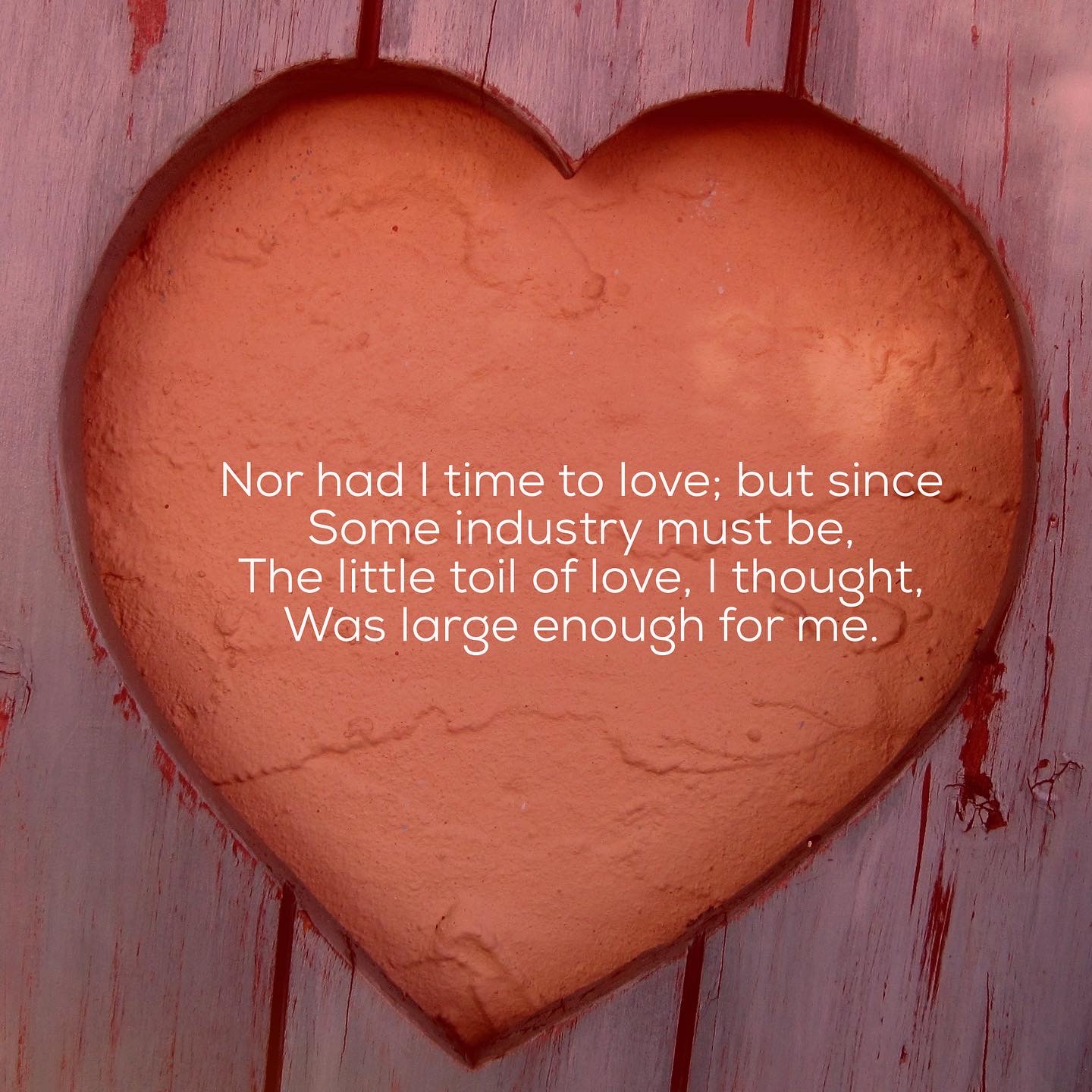
Nor had I time to love; but since       
Some industry must be,
The little toil of love, I thought,
Was large enough for me.


I touch God in my song


I touch God in my song
as the hill touches the far-away sea
with its waterfall.

The butterfly counts not months but moments,
and has time enough.

Let my love, like sunlight, surround you
and yet give you illumined freedom.

Love remains a secret even when spoken,
for only a lover truly knows that he is loved.

Emancipation from the bondage of the soil
is no freedom for thee.

In love I pay my endless debt to thee
for what thou art.

- Rabindranath Tagore

/ Photo by smerfeo /

Tagore and Karma Yoga: Focusing on Moments


…only a lover truly knows that he is loved.

In this poem’s few short lines, Rabindranath Tagore marries the bhakti path of utter love for God with the heart of karma yoga’s union through service and action.

In traditional Indian metaphysics, the goal is usually understood to be enlightenment and freedom from the karmic tug that traps us in the cycle of earthly embodiment, “emancipation from the bondage of the soil.” But here Tagore challenges the otherworldliness that often engenders.

Even the spiritual idea of liberation can become a selfish goal. For one utterly in love with God, the paying of that “debt” is simply a labor of love. Every effort, every experience, even suffering, is simply an expression of one’s love for God. That is enough right there for the true lover of God. Rather than seeking escape from “the soil,” the world is seen as a panorama that offers endless opportunities to worship and experience the Divine.

This is the great vision of karma yoga.

It is also the attitude that finally allows us to be at rest on our spiritual journey, rather than live as a convict on the run. What some see as the prison yard, becomes instead an exercise yard… or a playground! It is a courageous way of acknowledging that freedom is not escape, it is deep presence.

And we find that we live not in fleeting time, but in the ever expanding present moment.

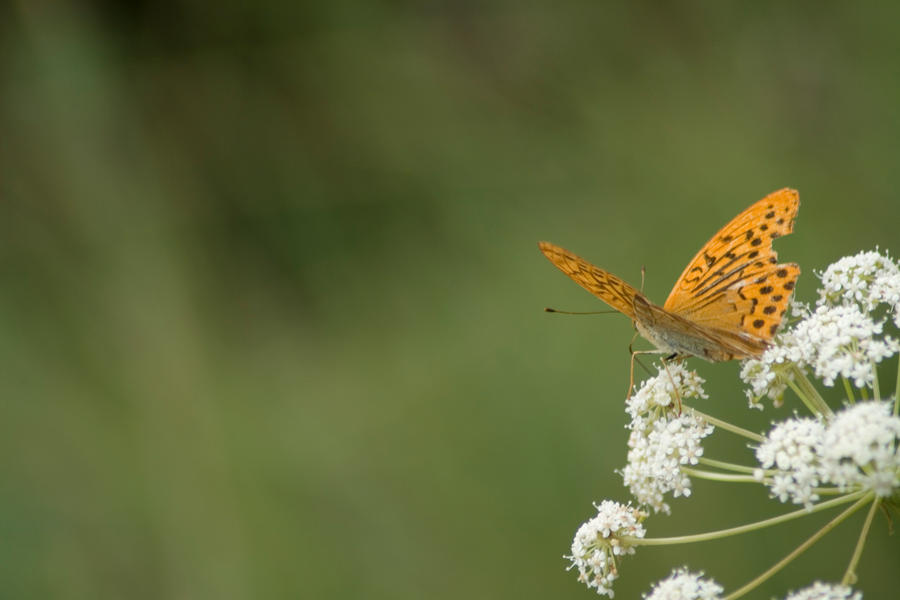
The butterfly counts not months but moments,
and has time enough.

Rabindranath Tagore

Background on Rabindranath Tagore


Rabindranath Tagore (sometimes rendered in a more modern transliteration as Thakur or Thakura) was one of the great writers of the early 20th century.

Rabindranath Tagore was born to a wealthy Brahmin family in Calcutta (Kolkata) in West Bengal during the British occupation of India.

His mother died when “Rabi” was a young child and his father’s responsibilities often required travel, leaving Rabindranath to be raised by elder siblings and family servants. His family was central to regional political, intellectual, and artistic social circles, however, ensuring that the young Tagore was exposed to great art and learning from an early age.

Tagore began composing poetry by the age of six and showed such a natural gift that he, at the age of sixteen, published a set of poems under a pseudonym that was mistakenly received by critics as a long-lost masterpiece. Only later was it revealed that the author was the adolescent Tagore.

As an older teenager, Tagore was sent to study in England, but soon left school to more actively feed his wide-ranging interests through self-study.

At the beginning of the 20th century, Tagore established an ashram as a place for learning, teaching, and agricultural experimentation.

Tagore was a strong advocate for Indian nationalism in opposition to British imperial rule, while criticizing the most violent expressions of revolution.

During his lifetime, Tagore traveled extensively, meeting the world’s great writers, scientists, political leaders, and social reformers.

Rabindranath Tagore was also an accomplished painter, as well as a musician and prolific composer, with more than 2,000 songs to his credit.

Tagore’s poetry draws from the rich devotional poetic traditions of India, but rendered in a highly fluid, contemporary style. His impact on world poetry and literature is immense, especially writing that explores the modern mind through the mystic’s lens. Countless literary figures of the 20th century cite Tagore as an important influence and source of inspiration. Although his library of poetry is extensive, his most widely read and loved collection is The Gitanjali.

In 1913, he became the first non-European to with the Nobel Prize in Literature.

More on this poem and Rabindranath Tagore from Poetry Chaikhana

I was composing an Iqbal ghazal today and ran across this beautiful ghazal by Siraj Aurangabadi, a sufi poet form Aurangabad form the 18th century.  Khabar-e-tahayyur-e-ishq sun is his most famous ghazal. The following note has three translations for this ghazal.  I also came across a great rendition of a few verses of this ghazal as a qawwali by Ustad Farid Ayaz and Ustad Abu Muhammad:


Lyrics


ḳhabar-e-tahayyur-e-ishq sun na junūñ rahā na parī rahī 
na to tū rahā na to maiñ rahā jo rahī so be-ḳhabarī rahī 

shah-e-be-ḳhudī ne atā kiyā mujhe ab libās-e-barahnagī 
na ḳhirad kī baḳhiya-garī rahī na junūñ kī parda-darī rahī 

chalī samt-e-ġhaib siiñ kyā havā ki chaman zuhūr kā jal gayā 
magar ek shāḳh-e-nihāl-e-ġham jise dil kaho so harī rahī 

nazar-e-taġhāful-e-yār kā gila kis zabāñ siiñ bayāñ karūñ 
ki sharāb-e-sad-qadah aarzū ḳhum-e-dil meñ thī so bharī rahī 

vo ajab ghaḌī thī maiñ jis ghaḌī liyā dars nusḳha-e-ishq kā 
ki kitāb aql kī taaq par juuñ dharī thī tyuuñ hī dharī rahī 

tire josh-e-hairat-e-husn kā asar is qadar siiñ yahāñ huā 
ki na ā.īne meñ rahī jilā na parī kuuñ jalvagarī rahī 

kiyā ḳhaak ātish-e-ishq ne dil-e-be-navā-e-'sirāj' kuuñ 
na ḳhatar rahā na hazar rahā magar ek be-ḳhatarī rahī 

Translation and Discussion

By Kashikeya Vats

Khabar-e-tahayyur-e-ishq sunn, na junoon raha na pari rahi
Na toh tu raha na toh mein raha, jo rahi so be-khabari rahi
On learning the amazing saga of love, neither the frenzy (junoon) was left, nor did the sweetheart (pari) remain. I was ‘me’ no more, you were ‘thee’ no more; only a state of oblivion remained.

This she'r reminds me of the lines from Rumi:

I always thought that
I was me — but no, I was you
and never knew it.

The consciousness of self is obstructive and it is only the removal of 'knowledge' and 'thought' (Rumi has used the words ‘thought’ and ‘knew’) that leads to the state of self-unconsciousness where the lover and the beloved become one.

Shah-e-bekhudi ne ataa kia, mujhay ab libas-e-barahanagi

Na khirad ki bakhiyagari rahi, na junoon ki pardadari rahi

The gift of the ‘Lord of Ecstasy’ to me was a garb of nakedness. All that the wisdom had stitched was gone; the veil of madness no longer remained.
At the spiritual level the couplet can be interpreted like this: My beloved, the shah-e-bekhudi has ripped naked my heart and soul, ridding them of the layers of stitching by the misguided intellect, which is nothing more than a veil of madness. The extreme of love endows the heart with divine purity. Reason and intellect have been viewed as hindrances, and the perceived sanity as madness. 
Chali simt-e-ghaib se aik hava, ke chaman zahoor ka jal gaya
Magar aik shakh-e-nihal-e-gham, jise dil kahe so hari rahi
A sweeping wind, which came from beyond the visible world, consumed the visible garden with fire; just one branch on the tree of grief, which they call heart, despite the blaze retained its green.
The reference here is to the lost Paradise, and the perennial quest to re-unite with it. The Divine breeze would burn the worldly existence leaving behind the hope for reunion. The worldly existence (chaman) has been likened to a tree of sorrow and suffering, and the Divine breeze as the liberator. Nothing grows on that tree except sadness, caused by the separation from his beloved. Now that entire existence is gone, only the abode of the beloved (heart) has survived.

Nazar-e-taghaful-e-yaar ka, gila kis zuban se bayan karoon
Ke sharab-e-sad-qadaah aarzu, khum-e-dil mein thi so bhari rahi
I am speechless to complain about the indifferent and uncaring glances (nazar-e-taghaful-e-yaar) of my beloved; the wine of desire that filled the heart remained suppressed, concealed.
At the temporal level, these lines would simply suggest that there is a heart overflowing with desires which one is unable to express due to the indifferent looks of the beloved. At the metaphysical level it would suggest that the worldly desires are often out of sync with the Divine commandments.

Woh ajab ghari thi mein jis ghari, liya dars nuskha-e-ishq ka
Ke kitab aql ki taaq main, jyun dhari thi tyun hi dhari rahi

It was at a moment strange that I read a book of love; the book of reason, brushed aside, remained shelved 
and sheathed.

Reason (aql-o-khirad), the product of mind is considered a detriment, hindering the spontaneity of heart. A person guided by logic and reason is too calculative to be able to devote to pure love; whereas selfless love is motivated by heart and not mind. For that reason love and brain are just incompatible. Mind is deceitful, untrustworthy, selfish and devious whereas heart is pure, untainted and selfless. As Iqbal said: bekhatar kuud para aatishe-namrood mein ishq/aql thi mehvi-tamasha-e-lab-baam abhi


Tere josh-e-hairat-e-husn ka, asar iss qadar so yahan hua
Ke na aayine main jila rahi, na pari kuun jalva gari rahi
Your bewitching beauty, love, such a spell did cast; the mirror stood bereft of gloss and beauty seemed to freeze.

Bewildered by your beauty (Josh-e-hairat-e-husn), I had such a mark on my heart (yahan is a pointer towards the heart) that the heart (aayina , the mirror of heart) has lost all its shine (the basic quality of a mirror) and angel (pari is used as simile to refer profound beauty) had no beauty left to reveal (‘kuun’means ko).

Kiya khak aatish-e-ishq ne dil-e-benava-e-Siraj ko
Na khatar raha na hazar raha, magar aik be-khatari rahi
The fire of love reduced to ashes Siraj’s voiceless heart; fears and cares got consumed, intrepid courage held the field.

The fire of love (aatish-e-ishq) has burnt the voiceless heart (dil-e-benava) of Siraj to ashes. The heart is so liberated from fears (be-khatari) that there is no feeling of vulnerability or threat left. (As Iqbal has used the word bekhatar: bekhatar kood para aatish-e-namrood mein ishq).

Second Translation


trans: Divana Nakujabadi [Saiyad Nizamuddin Ahmad]
The Tale of Love’s Perplexity (khabar-e tahayyur-e 'ishq)


[1]  Hearken to the tale of Love’s [metaphysical] perplexity:
   neither the ardour of madness remained,
   nor the angelic beloved remained;
 Neither did you remain, nor did I remain,
   only unawareness remained.


[2]  The Shah of no-self-ness has now bestowed upon me
   the garment of nakedness;
 Neither the stitching of reason remained,
   neither the veiling of madness’ ardour remained.

[3]  A wind blew from the threshold of the unseen,
   and the garden of bliss was consumed.
 Yet, but a branch of the tree of sorrow
   ―known as the heart― green remained.


[4]  With which tongue am I to recount the indifference of the beloved?
   Desire akin to the wine of a hundred goblets brimmed up
     in the vessel of the heart yet, therein remained.

[5]  What a marvelous instant it was that I learned of the elixir of Love!
   The book of reason placed on the shelf,
      on the shelf remained.

[6]  The intensity of the perplexity of your beauty,
   was so brilliantly revealed, that
    neither the mirror’s shine remained,
    neither the angelic beloved’s beauty remained.

[7]  The fire of love has reduced the mute heart of Siraj to ashes,
    neither fright remained,
    nor caution remained,
     only
fearlessness remained.


Third Translation


Khabar-e-tahayyur-e-ishq sunn, na junoon raha na pari rahi
Na toh tu raha na toh mein raha, jo rahi so be-khabari rahi
Learn oh absorbing love that neither the obsession (for the beloved) is left nor and the object (pari) of love survived. The only thing that is left is a state of self-unconsciousness: where neither you exist nor I exist.

Shah-e-bekhudi ne ataa kia, mujhay ab libas-e-barahanagi
Na khirad ki bakhiyagari rahi, na junoon ki pardadari rahi
My beloved (shah-e-bekhudi is a reference to the beloved. Knowing what little I know about Siraj I am leaning towards God as his object of love rather then a worldly being) has bestowed me with a dress of nakedness (libas-e-barahanagi). Neither the intellect (khirad) can repair it nor does the insanity (junoon) rip it. Meaning what a dress (nakedness) my beloved has conferred upon me! I am now free from the trouble of ripping it or mending it (depending on the mental state I am in). My focus is my beloved not my own appearance or even existence.

Chali simt-e-ghaib se aik hava, ke chaman zahoor ka jal gaya
Magar aik shakh-e-nihal-e-gham, jise dil kahe so hari rahi
A breeze came from the outer space (simt-e-ghaib) and burned the entire garden of existence (zahoor) but a branch of the tree of sorrow (nihal-e-gham) that is called heart remained green. Since in the first line poet is referring to a wind coming from the direction of God (ghaib) that has burned the whole existence (chaman) it can be assumed that tree of sorrow is a symbol of the poets own being. In the burned garden of existence he stood like a sad tree. Nothing grows on that tree except sadness, caused by the separation from his beloved. Now that entire existence is gone, only the abode of the beloved (heart) is survived.

Nazar-e-taghaful-e-yaar ka, gila kis zuban se bayan karoon
Ke sharab-e-sad-qadaah aarzu, khum-e-dil mein thi so bhari rahi
I am speechless (kis zuban). How can I complain the indifferent and uncaring glances (nazar-e-taghaful-e-yaar) of my beloved? After reading, the second line it is clear that he trying to say that I cannot complain about those cold looks or eyes that have granted me so much. I am indebted to those eyes. Why? My heart is brimming with his desire (aarzu) as if a vessel (khum) is filled with hundred goblets of wine (sharaab-e-sad-qadaah).

Woh ajab ghari thi mein jis ghari, liya dars nuskha-e-ishq ka
Ke kitab aql ki taaq main, jyun dhari thi tyun hi dhari rahi
In Urdu poetry, reason (aql-o-khirad) the product of mind is considered a source of selfishness and as it causes a person to make calculated move; as against altruistic emotions that come out of heart. A thoughtful person thinks about the consequences before taking any action. That is why it is assumed that a selfless love is motivated by heart and not mind. For that reason love and brain are just incompatible. Mind is deceitful, untrustworthy, selfish and devious whereas heart is pure, untainted and selfless. As Iqbal said:

bekhatar kuud para aatishe-namrood mein ishq aql thi mehvi-tamasha-e-lab-baam abhi

That is what Siraj is saying that at that strange moment when I started taking lesson in love (dars-e-nuskha-e-ishq) I left my intellect or brain (kitaab-e-aql- book is synonymous with intellect as one needs brain to read or write) in an alcove, where it is lying ever since.

Tere josh-e-hairat-e-husn ka, asar iss qadar so yahan hua
Ke na aayine main jila rahi, na pari kuun jalva gari rahi
Bewildered by your beauty (Josh-e-hairat-e-husn), I had such a mark on my heart (yahan is a pointer towards the heart) that the heart (aayina means heart) has lost all its shine (the basic quality of a mirror) and angel (pari is used as simile to refer profound beauty) had no beauty left to reveal. (“so” means se and “kuun” means ko).

Kiya khak-e-aatish-e-ishq ne dil-e-benava-e-Siraj ko
Na khatar raha na hazar raha, magar aik be-khatari rahi
The fire of love (aatish-e-ishq) has burned the voiceless heart (dil-e-benava) of Siraj to the ashes. There is no feeling of vulnerability or threat left. Only freedom from fear (be-khatari) is left. (As Iqbal has used the word bekhatar: bekhatar kood para aatish-e-namrood mein ishq.)


Mahi ve tere bajoN dil deya meharma ve
sada jeuuna kere chaj daa ay
meri loo loo vich meri nas nas wich
teri yaad da tumbaa vajdaa ay

Without you
Without you, my heart's desire
There's no point in living without you
Every vein sings your name

Akhiyan udeek diyan dil vajaa maarda
aja pardesiya vaasta ii pyaar da

My eyes wait for you, my heart calls you 
Come back home for the sake of our love

Jado da tu rus giya sade nal dholnaa
bhul gaya kawaaN nu banairay utte bolna

Since you left, I have felt utterly alone
Crows don't sing on the window sill

KaliaN nai meraa ji lagda 
bahaaraan aake lang chaliyaan
tu chetti aja dholna

I cannot bear this loneliness
Spring has come and it has gone
But still i wait for you

Hun , je na aaya fir kehre wele aawega?
Panchi murr gharaN nu aa gaye tu vi aaja dholna
tenu akhiyan udeek diyan

If not now, when will you come?
The birds of spring are here again
Why do you not come too?

Arriaa na kar beparwaiaaN ve 
rutaaN pyaar karan diyaN aayiaN
//chetti aaja dholna tenu akhiyan udeek diyan

Don't fail me, I beg to you, 
In this loving season, come back
Come back, my love, come back My eyes waiting…

PiplaaN te peengaaN payiaaN 
ral mil geet de gaundiaN sayiaN
//chetti aaja dholna tenu akhiyan udeek diyan

My friends call celebrate and sing
Sing the songs of love
Won't you come too, my love?..

RawaN tak tak thakh gayi aaN meiN
kaliaN reh reh ak gayi aaN meiN
ik ik pal dil gin ke guzaar da
aaja pardesiya vasta ii pyaar da
aaja tenu akhiyan udeek diyan-

I watch the streets and roads
I am forlorn, waiting for you
I count each moment
Each minute
Come back, my love


Uth uth jaan namazi masjid menu tatti nu teriyaN tangaN
Hun te aaja ve aaja ve… chheti aaja dholna

The devout go to the mosque to pray
But I just sit watching the way
Now, come back, my love, come love…

Bhul gayiaaN te rus gaye chaa ve
aj pata laga ay vichora ki bala ae
aaja tenu akhiyan udeek diyan-

Happiness has turned its face away
Joy has been banished from my life
Come love, My eyes wait for you to come…

Sajna ve tere bajoN lagda na jee ve 
jithe jaa ke beh gaya uthe tera kii ve 
aaja tenu akhiyan udeek diyan-

lover, I can no longer live
No longer live without you
What do you get by doing this to me?

Poore di hawa chale dil mera dolda
kamb kamb jawa jadoN kaaN kitte bolda
aawaiN te sunawaN meiN vichora kiwe marda
aaja pardesiya vasta ii pyaar da
aaja tenu akhiyan udeek diyan-

The easterly breeze brings only sorrow
I shudder when I hear the birds sing
If only you could see how I suffer
I beg you, please come back to me
Come My eyes waiting…

Tere waloN puchde ne galiaN de baal ve 
gum sum howaN jedoN karde sawaal ve
marda ay taanay menu mausam bahaar da
aaja pardesiya vasta ii pyaar da
aaja tenu akhiyan udeek diyan-

The street urchins make fun of me
I walk by, lost in though, alone
The seasons taunt my loneliness
Come back, come back, my love

Aaja dholna tenu akhiyan udeek diyan
chetti aaja dholna tenu akhiyan udeek diyan (Chants)

Come love, Come love, My eyes wait for you to come…
Come back, my love, come back My eyes waiting…

Akhiyan udeek diyan dil vajaa maarda


Altered Lyrics

Mahi ve tere bajoN dil deya meharma ve
sada jeuuna kere chaj daa ay
meri loo loo vich meri nas nas wich
teri yaad da tumbaa vajdaa ay

Without you
Without you, my heart's desire
There's no point in living without you
Every nerve and vein sings your name

Akhiyan udeekdiyan dil vajaa maarda
aja pardesiya vaasta ii pyaar da
Aa Ja tainu akhiyaan udeekdiyaan

[should be akhiyaan udeekdiyaan - udeekda is one word, udeekdiyaan is feminine plural for "waiting"]

My eyes wait for you, my heart calls you 
Come back home for the sake of our love
Come back, my eyes wait for you

Jado da tu rus giya sade nal dholnaa
bhul gaya kawaaN nu banairay utte bolna

Since you left, I have felt utterly alone
Crows don't sing on the window sill

[Also see Aiwain Bol Na Banere Utte Kaavaan]


Sab galaan karde jeen diyaan
mar mukeyaan da koi ki lagda
bahaaraan aake lang chaliyaan
ik jee bajon nai ji lagdaa

tu chetti aja dholna
KaliaN nai meraa ji lagda 


I cannot bear this loneliness
Spring has come and it has gone
But still i wait for you

Hun , je na aaya fir kehre wele aawega?
Panchi murr gharaN nu aa gaye tu vi aaja dholna
tenu akhiyan udeek diyan

If not now, when will you come?
The birds of spring are here again
Why do you not come too?


Arriaa na kar beparwaiaaN ve 
rutaaN pyaar karan diyaN aayiaN
//chetti aaja dholna tenu akhiyan udeek diyan

Don't fail me, I beg to you, 
In this loving season, come back
Come back, my love, come back My eyes waiting…


PiplaaN te peengaaN payiaaN 
ral mil geet de gaundiaN sayiaN
//chetti aaja dholna tenu akhiyan udeek diyan

My friends call celebrate and sing
Sing the songs of love
Won't you come too, my love?..


RawaN tak tak thakh gayi aaN meiN
kaliaN reh reh ak gayi aaN meiN
ik ik pal dil gin ke guzaar da
aaja pardesiya vasta ii pyaar da
aaja tenu akhiyan udeek diyan-

I watch the streets and roads
I am forlorn, waiting for you
I count each moment
Each minute
Come back, my love


Uth uth jaan namazi masjid menu tatti nu teriyaN tangaN
Hun te aaja ve aaja ve… chheti aaja dholna

The devout go to the mosque to pray
But I just sit watching the way
Now, come back, my love, come love…


Pul gayiaaN te rus gaye chaa ve
aj pata laga ay vichora ki bala ae
aaja tenu akhiyan udeek diyan-

Happiness has turned its face away
Joy has been banished from my life
Come love, My eyes wait for you to come…


Sajna ve tere bajoN lagda na jee ve 
jithe jaa ke beh gaya uthe tera kii ve 
aaja tenu akhiyan udeek diyan-

lover, I can no longer live
No longer live without you
What do you get by doing this to me?


Poore di hawa chale dil mera dolda
kamb kamb jawa jadoN kaaN kitte bolda
aawaiN te sunawaN meiN vichora kiwe marda
aaja pardesiya vasta ii pyaar da
aaja tenu akhiyan udeek diyan-


The easterly breeze brings only sorrow
I shudder when I hear the birds sing
If only you could see how I suffer
I beg you, please come back to me
Come My eyes waiting…

Tere waloN puchde ne galiaN de baal ve 
gum sum howaN jedoN karde sawaal ve
marda ay taanay menu mausam bahaar da
aaja pardesiya vasta ii pyaar da
aaja tenu akhiyan udeek diyan-

The street urchins make fun of me
I walk by, lost in though, alone
The seasons taunt my loneliness
Come back, come back, my love

Aaja dholna tenu akhiyan udeek diyan
chetti aaja dholna tenu akhiyan udeek diyan (Chants)

Come love, Come love, My eyes wait for you to come…
Come back, my love, come back My eyes waiting…

Akhiyan udeek diyan dil vajaa maarda


Abrar Ahmad - Nazm

is ghar meñ yā us ghar meñ 

is ghar meñ yā us ghar meñ 
tū kahīñ nahīñ hai 
darvāze bajte haiñ 
ḳhālī kamre 
terī bātoñ kī mahkār se bhar jaate haiñ 
dīvāroñ meñ 
terī sāñseñ soī haiñ 
maiñ jaag rahā huuñ 
kānoñ meñ 
koī guuñj sī chakrātī phirtī hai 
bhūle-bisre gītoñ kī 
chāñdnī raat meñ khilte hue 
phūloñ kī damak hai, yahīñ kahīñ 
tere ḳhvāb 
mirī be-sāya zindagī par 
bādal kī sūrat jhuke hue haiñ 
yaad ke dasht meñ 
āñkheñ kāñTe chuntī haiñ 
mere haath 
tire hāthoñ kī ThanDak meñ 
Duube rahte haiñ 
āḳhir... terī miTTī se mil jaane tak 
kitne pal 
kitnī sadiyāñ haiñ 
is sarhad se 
us sarhad tak 
kitnī masāfat aur paḌī hai 
un rastoñ meñ 
kitnī bārisheñ baras ga.ī haiñ 
āñkheñ mirī 
terī rātoñ ko taras ga.ī haiñ 

Reading A Prayer in Spring, a poem about gratitude and love. 


A Prayer in Spring
- Robert Frost

Oh, give us pleasure in the flowers to-day;
And give us not to think so far away
As the uncertain harvest; keep us here
All simply in the springing of the year.

Oh, give us pleasure in the orchard white,
Like nothing else by day, like ghosts by night;
And make us happy in the happy bees,
The swarm dilating round the perfect trees.

And make us happy in the darting bird
That suddenly above the bees is heard,
The meteor that thrusts in with needle bill,
And off a blossom in mid air stands still.

For this is love and nothing else is love,
The which it is reserved for God above
To sanctify to what far ends He will,
But which it only needs that we fulfil.
Today I am reading Putting in the Seed by Robert Frost this spring while meditating on Leaves Compared with Flowers and wondering about how most poets are afflicted with this "springtime passion for the earth." Interesting that Robert Frost is so self-aware and self-deprecating, a great quality in a poet. Through this Shakespearean sonnet, reader can reflect upon how “sowing a seed” is related human love and life.  The reader marvels at how small this seed is, yet how sturdy. This is from where the root will come, and like Kabir says, the root will lead you to the branch, the leaf, the flower, and the fruit. 


Putting in the Seed

Robert Frost

You come to fetch me from my work to-night 
When supper's on the table, and we'll see 
If I can leave off burying the white 
Soft petals fallen from the apple tree. 
(Soft petals, yes, but not so barren quite, 
Mingled with these, smooth bean and wrinkled pea;) 
And go along with you ere you lose sight 
Of what you came for and become like me, 
Slave to a springtime passion for the earth. 
How Love burns through the Putting in the Seed 
On through the watching for that early birth 
When, just as the soil tarnishes with weed, 
The sturdy seedling with arched body comes 
Shouldering its way and shedding the earth crumbs.


Notes from Others

1. Frost is at the dinner table for his final meal of the day. His personal season of fertility is over. He observes. He is aware of the trials for the seed. But the seed is already planted and he cannot control it with his own will. It will grow without Frost’s control. The trick is to watch and allow life to be.

2. The poem is literally about a woman who comes to tell a man his supper is ready. She gets distracted working with the man. They discover they both enjoy planting and watching the seeds grow.

Awake ye muses nine, sing me a strain divine,
Unwind the solemn twine, and tie my Valentine!

Oh the Earth was made for lovers, for damsel, and hopeless swain,
For sighing, and gentle whispering, and unity made of twain.
All things do go a courting, in earth, or sea, or air,
God hath made nothing single but thee in His world so fair!
The bride, and then the bridegroom, the two, and then the one,
Adam, and Eve, his consort, the moon, and then the sun;
The life doth prove the precept, who obey shall happy be,
Who will not serve the sovereign, be hanged on fatal tree.
The high do seek the lowly, the great do seek the small,
None cannot find who seeketh, on this terrestrial ball;
The bee doth court the flower, the flower his suit receives,
And they make merry wedding, whose guests are hundred leaves;
The wind doth woo the branches, the branches they are won,
And the father fond demandeth the maiden for his son.
The storm doth walk the seashore humming a mournful tune,
The wave with eye so pensive, looketh to see the moon,
Their spirits meet together, they make their solemn vows,
No more he singeth mournful, her sadness she doth lose.
The worm doth woo the mortal, death claims a living bride,
Night unto day is married, morn unto eventide;
Earth is a merry damsel, and heaven a knight so true,
And Earth is quite coquettish, and beseemeth in vain to sue.
Now to the application, to the reading of the roll,
To bringing thee to justice, and marshalling thy soul:
Thou art a human solo, a being cold, and lone,
Wilt have no kind companion, thou reap'st what thou hast sown.
Hast never silent hours, and minutes all too long,
And a deal of sad reflection, and wailing instead of song?
There's Sarah, and Eliza, and Emeline so fair,
And Harriet, and Susan, and she with curling hair!
Thine eyes are sadly blinded, but yet thou mayest see
Six true, and comely maidens sitting upon the tree;
Approach that tree with caution, then up it boldly climb,
And seize the one thou lovest, nor care for space, or time!
Then bear her to the greenwood, and build for her a bower,
And give her what she asketh, jewel, or bird, or flower —
And bring the fife, and trumpet, and beat upon the drum —
And bid the world Goodmorrow, and go to glory home!


Background: An Unusual Emily Dickinson Poem Urging a Young Man to Marry 

This is definitely an unusual poem by Emily, perhaps her early ones. It has a very different meter. It is much longer than her characteristic poems. More importantly, it lacks the convolutions and mystery of her later work which makes her later work so wondrous. But it is still joyful for me. 

The poem opens with an invocation to the muses, but then instead of splitting into quatrains, which most of Dickinson's poems do, it sits in one lump chunk on the page. Gone is her Germanic style capitalization of nouns and her liberal sprinkling of dashes; although she does manage to insert a couple of dashes into the final three lines!

Emily's speaker is addressing a young man, exhorting him to select a sweetheart and marry her. The main theme of this poem, then, plays out similar to the Shakespearean "Marriage Sonnets," in which the speaker also is urging a young man to marry. However, instead of the urgent seriousness of the Shakespearean sonnets, Dickinson's poem is a playful Valentine.

According to Richard B. Sewall's The Life of Emily Dickinson, that young man is Elbridge Bowdoin, who served as a partner in Emily's father's law office. Emily's Valentine poem, sent in 1850 with the return of a book to Bowdoin, may be seen as flirtatious; however, Bowdoin did not seem to notice or anyway spurned the advice of the poem, remaining a bachelor for life.

My Favorite Themes: 1. Oneness 


Awake ye muses nine, sing me a strain divine,
Unwind the solemn twine, and tie my Valentine!

Oh the Earth was made for lovers, for damsel, and hopeless swain,
For sighing, and gentle whispering, and unity made of twain.

Longer poems whether they are Indian classics like Ramayana and Mahabharata, or Bhagwad Gita, or Guru Granth Sahib, start with an invocation. Here Emily Dickinson playfully adds an invocation to all nine muses to help her the most important activity that she is going to be talking about in this poem.

She claims that the purpose for anyone to be on earth is to fall in love, for all those plays of love like sighing and whispering and for two to become one.  I love the rhymes here. The lines reminds me of Guru Arjan's Gobind Milan Ki Eh Teri Bariya. You have attained this human birth so you can be one with Gobind. 

My Favorite Themes: 2. Wedding Guests 


The bee doth court the flower, the flower his suit receives,
And they make merry wedding, whose guests are hundred leaves;

The reference of the wedding guests reminds me of Kabir's Gao Gao Ri Dulhai: Sing O Soul bride, Sing songs of bliss for King Raam has come home to wed me.

My Favorite Themes: 3. Mortality 


The worm doth woo the mortal, death claims a living bride,
Night unto day is married, morn unto eventide;

Mostly this is a light-hearted poem. So its interesting to also have death included. She is trying to say love is unavoidable like death.  


Comments from Readers


Jodde: "Frankly I think it’s absolutely brilliant how Dickinson is able to weave together the Old and New Testament. The references to Adam and Eve are obvious, and it is obvious that these people are written of in the Old Testament. After explaining how Adam and Eve were the original lovers and that the Earth was made for them, she rewords Jesus’ “seek and ye shall find” and does so beautifully. The poem seems to be about seeking love, and Dickinson is confident that she will find it. Though she may have never found it in a marital sense, she certainly found it in the adoration of her work. Anyway, the whole poem illustrates her brilliant use of Scripture."


More:
Mark Twain on Marriage


Older Posts Home

SHIVPREET SINGH

Singing oneness!
- Shivpreet Singh

Related Posts

Popular - 30 days

  • Vande Mataram - Lyrics and Translation
    I love the Vande Maataram composition in Raag Des sung by Lata Mangeshkar.  Vande Mataram is the national song of India. In 2003, BBC World ...
  • Man Atkeya Beparwah De Naal - Lyrics and Translation of Shah Hussain
    Man Atkeya Beparwah De Naal - Listening and Singing this kaafi by Shah Hussain today ...  https://www.youtube.com/watch?v=SkYN2XlK1Vg Raag J...
  • Kabir's Gao Gao Ri Dulhani - Lyrics and meanings
    One of my favorite Kabir's poem I call "Dulhani." In this beautiful poem, Kabir envisions himself as the bride and the univers...
  • Earth Day - Finding Peace in Wild Things, and Freedom on Earth
    Those who find love in nature discover a deep and lasting freedom—and in turn, inspire others to seek that same liberation. Poetry, I believ...
  • Dr Manzur Ejaz on Baba Guru Nanak
    I am listening to a lecture by Dr Manzur Ejaz today. He describes one of Guru Nanak's Babarvani shabads at the beginning: Jaisi Main Ave...
  • The Many Types of Raag Malhar
    Pour love in your heart, like the rain pours on the land today. As I am working on a Meerabai song I am doing research on the different vari...
  • Gulon Mein Rang Bhare - Lyrics and Translation of Mehdi Hassan Ghazal
    I was listening and meditating upon this beautiful ghazal by Faiz Ahmed Faiz, beautifully composed by Mehdi Hassan. It is one of my favorite...
  • Sanson Ki Mala Pe - Lyrics, Translation and Background
    Sanson ki Maala was made famous by Nusrat Fateh Ali Khan sahib.  Although some have attributed this song to Mirabai and Khusro, this is a gh...
  • Ve Mahiya Tere Vekhan Nu - Tufail Niazi and Wadali Brothers
    I have recently heard this Bulleh Shah song and it has really touched my heart. Several people have sung it, but I love the original composi...
  • Nasro Mansoor Guru Gobind Singh - Bhai Nand Lal Goya
    I have been singing this shabad for over 30 years; I composed it when I was a teenager. It comes from a fairly long poem of 55 couplets, lyr...

Blog Archive

  • ▼  2026 (10)
    • ▼  April (1)
      • Following the Daisy Because Love is Sweet - Reflec...
    • ►  March (6)
    • ►  February (1)
    • ►  January (2)
  • ►  2025 (24)
    • ►  October (5)
    • ►  September (7)
    • ►  August (2)
    • ►  July (2)
    • ►  June (3)
    • ►  March (1)
    • ►  February (2)
    • ►  January (2)
  • ►  2024 (21)
    • ►  December (1)
    • ►  November (2)
    • ►  October (3)
    • ►  September (2)
    • ►  August (4)
    • ►  July (2)
    • ►  June (3)
    • ►  May (1)
    • ►  April (1)
    • ►  February (1)
    • ►  January (1)
  • ►  2023 (41)
    • ►  December (4)
    • ►  November (3)
    • ►  October (4)
    • ►  September (7)
    • ►  August (5)
    • ►  July (7)
    • ►  June (3)
    • ►  May (3)
    • ►  April (1)
    • ►  March (1)
    • ►  February (3)
  • ►  2022 (8)
    • ►  March (2)
    • ►  January (6)
  • ►  2021 (139)
    • ►  December (15)
    • ►  November (2)
    • ►  October (6)
    • ►  September (7)
    • ►  August (2)
    • ►  July (4)
    • ►  May (21)
    • ►  April (21)
    • ►  March (35)
    • ►  February (23)
    • ►  January (3)
  • ►  2020 (150)
    • ►  December (2)
    • ►  November (13)
    • ►  October (32)
    • ►  September (47)
    • ►  August (37)
    • ►  July (5)
    • ►  June (3)
    • ►  May (3)
    • ►  April (3)
    • ►  March (2)
    • ►  February (1)
    • ►  January (2)
  • ►  2019 (43)
    • ►  December (5)
    • ►  November (8)
    • ►  October (13)
    • ►  September (4)
    • ►  July (3)
    • ►  June (1)
    • ►  May (2)
    • ►  March (1)
    • ►  February (1)
    • ►  January (5)
  • ►  2018 (53)
    • ►  December (8)
    • ►  November (5)
    • ►  October (3)
    • ►  September (4)
    • ►  August (6)
    • ►  July (3)
    • ►  June (4)
    • ►  May (6)
    • ►  April (5)
    • ►  March (2)
    • ►  February (4)
    • ►  January (3)
  • ►  2017 (73)
    • ►  December (2)
    • ►  November (12)
    • ►  October (8)
    • ►  September (1)
    • ►  August (7)
    • ►  July (6)
    • ►  June (12)
    • ►  May (5)
    • ►  April (4)
    • ►  March (8)
    • ►  February (3)
    • ►  January (5)
  • ►  2016 (141)
    • ►  December (1)
    • ►  November (9)
    • ►  October (16)
    • ►  September (19)
    • ►  August (2)
    • ►  July (5)
    • ►  June (7)
    • ►  May (3)
    • ►  April (18)
    • ►  March (34)
    • ►  February (16)
    • ►  January (11)
  • ►  2015 (28)
    • ►  December (1)
    • ►  November (1)
    • ►  October (2)
    • ►  September (12)
    • ►  August (1)
    • ►  May (1)
    • ►  April (7)
    • ►  March (1)
    • ►  February (1)
    • ►  January (1)
  • ►  2014 (107)
    • ►  December (1)
    • ►  November (6)
    • ►  October (1)
    • ►  August (2)
    • ►  July (1)
    • ►  June (11)
    • ►  April (10)
    • ►  March (15)
    • ►  February (24)
    • ►  January (36)
  • ►  2013 (242)
    • ►  December (13)
    • ►  October (5)
    • ►  September (3)
    • ►  August (3)
    • ►  June (7)
    • ►  May (62)
    • ►  April (79)
    • ►  March (12)
    • ►  February (23)
    • ►  January (35)
  • ►  2012 (145)
    • ►  December (29)
    • ►  November (31)
    • ►  October (44)
    • ►  September (5)
    • ►  August (9)
    • ►  July (7)
    • ►  June (1)
    • ►  May (3)
    • ►  April (1)
    • ►  March (4)
    • ►  February (9)
    • ►  January (2)
  • ►  2011 (252)
    • ►  December (1)
    • ►  November (1)
    • ►  October (4)
    • ►  September (13)
    • ►  August (28)
    • ►  July (44)
    • ►  June (33)
    • ►  May (15)
    • ►  April (2)
    • ►  March (45)
    • ►  February (43)
    • ►  January (23)
  • ►  2010 (70)
    • ►  December (31)
    • ►  November (20)
    • ►  October (2)
    • ►  September (3)
    • ►  August (1)
    • ►  July (2)
    • ►  May (5)
    • ►  March (4)
    • ►  February (1)
    • ►  January (1)
  • ►  2009 (15)
    • ►  December (1)
    • ►  November (3)
    • ►  October (2)
    • ►  September (2)
    • ►  August (1)
    • ►  June (1)
    • ►  April (1)
    • ►  March (1)
    • ►  February (1)
    • ►  January (2)
  • ►  2008 (15)
    • ►  November (1)
    • ►  July (2)
    • ►  June (5)
    • ►  May (1)
    • ►  April (2)
    • ►  March (1)
    • ►  February (1)
    • ►  January (2)
  • ►  2007 (9)
    • ►  November (4)
    • ►  October (2)
    • ►  September (1)
    • ►  August (2)
  • ►  1999 (1)
    • ►  May (1)

Message

Name

Email *

Message *

Twitter

Tweets by @shivpreetsingh


Copyright © Shivpreet Singh. Designed by OddThemes